
Every agency owner can feel the shift happening across the industry. Your Team is testing prompts in between projects. Your feed is filled with tools that promise to rewrite content, automate strategy, or replace entire roles with the click of a button. AI is no longer a concept we are preparing for someday. It is already influencing the expectations clients bring to the table and the efficiency pressures agencies are beginning to feel.
Some agency owners are leaning in and experimenting. Others are quietly worried that their expertise might lose value. Many feel overwhelmed, not because they lack interest, but because the noise surrounding AI is louder than the clarity. Every headline presents a new tool. Every video claims another breakthrough. The real question is no longer “Is AI coming” but “How do we use it in a way that strengthens our agency instead of diluting what makes us valuable”
The encouraging part is that you do not need to chase tools endlessly or rebuild your agency from the ground up. The opportunity is much more grounded. Use AI to support your expertise, not replace it. Turn the intellectual property you already have into something AI can amplify. Reinvest the time savings into deeper thinking, better work, and more distinctive outcomes. That is where the real advantage lives.
The Tool Treadmill Will Slow You Down
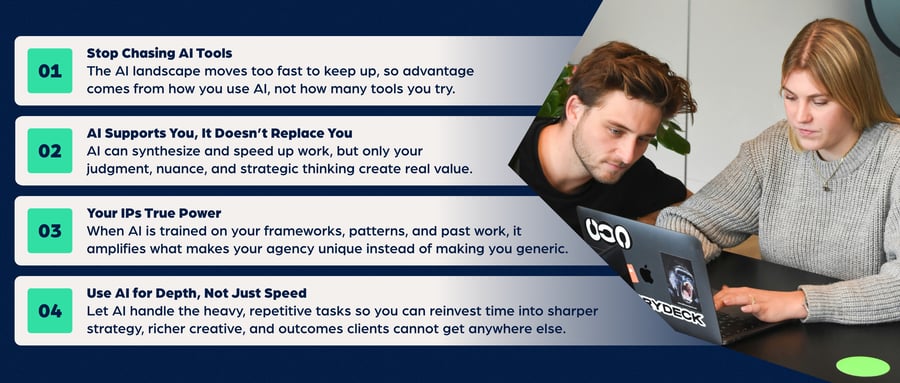
One of the biggest traps agency owners fall into is the “best tool” mindset. Every week brings a new platform that promises smarter automation or more advanced capabilities. It is tempting to feel like you need to keep up, but the pace is impossible. You test a tool, spend time learning it, start to integrate it, and suddenly a new option appears that seems even better. The cycle starts again, leaving you with more logins than leverage.
This endless tool chasing becomes exhausting and ineffective. More importantly, it pulls focus away from what actually creates advantage.
It causes predictable problems:
- You spend hours learning tools you never fully implement.
- Your team becomes unsure which tool to use and when.
- Your processes become inconsistent because tools change too often.
- You accumulate technology but do not build capability.
Tools are commodities, and often fruitless ones. Anyone can sign up for them. If every agency uses the same set of tools in the same way, nobody stands out. The agencies that win will not be the ones with the largest stack. They will be the ones with the clearest thinking about how AI fits into their workflow, their decisions, and their value.
This is why shifting the question from “Which tool should we use” to “How does AI support the way we think and deliver value” changes everything. The second question opens the door to strategy, not overwhelm.
AI Cannot Replace Your Thinking
There is a misconception circulating that AI can think for you, strategize for you, or replace senior talent. It cannot. AI predicts patterns based on existing data. It can move quickly, and it can produce endless variations. But it does not understand context, nuance, brand politics, or the lived experience behind strong creative and strategy.
AI is strong at:
- Synthesizing large amounts of text.
- Spotting surface level patterns.
- Drafting variations based on known inputs.
- Organizing raw information quickly.
But it is weak at:
- Understanding emotional nuance.
- Identifying subtle brand risks.
- Making strategic trade offs.
- Interpreting unspoken dynamics in client conversations.
- Evaluating creative beyond pattern matching.
AI will often produce confident answers that are incorrect or too shallow to rely on. If you allow AI to replace your thinking, your work becomes generic and undifferentiated. What makes your agency valuable is your perspective, your frameworks, your lived experience, and your ability to connect the dots in ways clients cannot.
When you pair that with AI’s capacity to process more information than any human can manually, your work becomes sharper, not shallower. You bring the judgment and direction. AI brings speed and synthesis. Together, they create more powerful outcomes than either could alone.
Turning Your IP Into AI Ready Knowledge
Every agency has intellectual property that is far more valuable than any tool. It lives in the questions you ask during discovery, the frameworks you use for strategy, the signals you look for in research, and the instincts your senior team has built over years. The issue is that most of this knowledge is unstructured. It sits in documents, Slack messages, personal notes, and the heads of team members.
To make AI truly useful, this knowledge needs to be broken down into smaller, more structured pieces. A helpful way to picture this is the Jenga analogy. Imagine your agency’s expertise is a tall tower. To make it accessible to AI, you need to pull each block out and lay it flat on the table. Each block becomes a piece of logic, a decision rule, a pattern you rely on, or a repeatable step your team uses consistently.
When your expertise is structured this way, AI can begin operating inside your worldview. It pulls from your logic, your standards, your vocabulary, and your patterns rather than generic internet knowledge. This is what gives you differentiation. No one else has your internal dataset or your unique approach. When AI learns from your world instead of the public web, it strengthens your agency instead of making you sound like everyone else.
Where AI Strengthens Your Workflow
AI makes the biggest impact in areas where information volume is high and human judgment is still essential. It helps you move faster without sacrificing quality and gives your team more mental space for high value thinking. In most agencies, this shows up in a few specific places.
AI can accelerate:
- Research and synthesis by scanning articles, transcripts, competitor sites, and reports, then summarizing what matters.
- Persona refinement by clustering insights from past work, customer quotes, audience patterns, and ICP documents.
- Early creative exploration by producing low fidelity directions your team can evaluate and refine.
- Market comparisons by highlighting similarities, differences, and hidden opportunities across multiple brands or verticals.
AI does not replace the strategist or creative director. It reduces friction. It removes the time spent on manual synthesis and gives your team more time to think, evaluate, and innovate.
Efficiency Alone Is Temporary
There is a real efficiency opportunity available right now. If a project that previously required 100 hours can be completed with equal or better quality in 60 or even 50, you gain meaningful flexibility. That time can be used in three ways.
You can:
- Keep pricing the same and improve margins.
- Reduce pricing to compete more aggressively.
- Or reinvest the saved time into deeper thinking and better results.
The third option is the real opportunity. The market will eventually recognize that certain tasks can be done faster. Price sensitivity will increase. Agencies that rely only on efficiency will be pulled into comparisons they cannot win.
Agencies that reinvest part of their time savings into more thoughtful research, stronger creative development, richer insights, and clearer strategic recommendations will stand out. They will be seen as partners, not vendors. They will deliver outcomes that clients cannot get from generic AI outputs or low cost competitors.
Efficiency is short term. Differentiation is durable.
Your Untapped Data Holds Enormous Potential
Most agencies are sitting on years of data without realizing how valuable it is. Old proposals, reports, interviews, content audits, call transcripts, and internal notes all hold patterns that can strengthen your work. The problem is that this information is fragmented across drives, inboxes, and tools.
When you begin gathering and structuring this information into one place, it becomes a private dataset that only your agency has. This is where real AI advantage comes from. Once your dataset is organized, AI can pull from:
- Your evaluation criteria.
- Your case studies and outcomes.
- Your patterns of decision making.
- Your Past Strategy and Creative Work.
- Your wins and your lessons.
No competitor has this combination. Your internal dataset becomes your moat. It allows AI to deliver insights and synthesis that feel like your agency, not a generic model. That is when your work becomes uniquely differentiated.
Build a Lean AI Layer That Supports Your Workflow
You do not need a massive stack to start. A lean AI layer is more effective than a complex one. This layer might include a central database of your frameworks, insights, and client context, one or two AI tools that are consistently used for research or concepting, and a routine for capturing learnings from every project.
The goal is not to transform your agency overnight. The goal is to create a supportive layer under your existing process. You want your team to think with clarity while AI handles the heavy lifting of gathering, organizing, and synthesizing information. When this foundation is in place, everything your agency produces becomes easier, faster, and higher quality.
What AI Should Make Possible
When implemented well, AI should free up space for the work that truly differentiates your agency. You should see deeper insights because you can access more information. You should see clearer strategic direction because AI helps you structure your thinking. You should see more creative experimentation because initial iterations are faster. You should see stronger recommendations because you have more evidence and patterns to support your decisions.
AI should not replace your senior team or produce generic outputs. It should elevate your thinking and make it more scalable.
Where to Focus First
If you want a clear and grounded starting point, focus on the parts of your workflow that feel slow because of research, manual aggregation, or repetitive formatting. Choose one or two areas where AI could support the process. Begin structuring your IP so that it is not scattered across random documents. And keep the human element front and center. Your team should always make the judgment calls.
You are not behind. You do not need to become an expert in every new tool. You only need a clear understanding of how AI can support your expertise and help you create more value, not less.
AI is not the hero of your agency. Your thinking is. When you let AI handle the heavy, repetitive parts and help you access what you already know, you build an agency that is not only faster, but smarter, sharper, and significantly harder to replace.