
Most agency owners know they need to invest to grow. They know they cannot stay stuck in survival mode forever. But when it comes time to spend money, doubt creeps in. Should you hire that accounts lead now or wait? Should you increase ad spend or invest in a new tool? Should you pull the trigger on a role that would give you your time back or keep pushing through because you are afraid of the cost?
Deciding where to invest often becomes a battle between gut instinct and fear. Many owners spend money based on emotion, or they delay making decisions until it is too late. Neither leads to sustainable, profitable growth. Growth becomes unpredictable and stressful rather than strategic and confident.
A growth ready operational budget changes that. Instead of being a backward looking document, your budget becomes a forward focused tool that guides decisions, reduces uncertainty, and helps you allocate resources in a way that aligns with your goals, team capacity, and desired owner lifestyle.
This approach allows you to look beyond the number in your bank account and understand what spending is aligned with where the business is going, not just where it is today.
Your Budget Must Guide Decisions, Not Just Track Expenses
Most agency budgets are created as snapshots of the past. They show what you spent, what you earned, and what is left over. That information has value, but it does not help you make better decisions about what comes next.
A growth ready budget answers strategic questions such as:
- What level of revenue are we planning to support this year?
- If we grow at our current trend, what will we need from a staffing or delivery perspective?
- If we hit our stretch goals, what investments must be made ahead of time?
- If we fall short of goals, what expenses can be delayed without harming performance?
This turns your budget into a tool for intentional growth instead of reactive cost tracking.
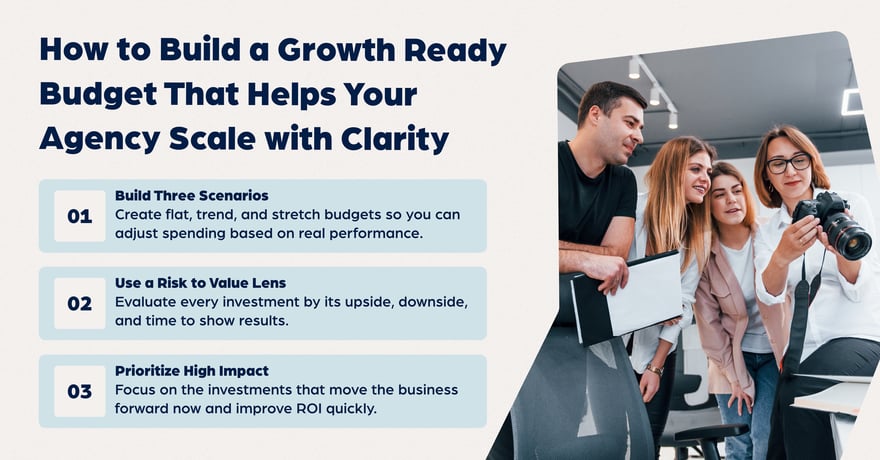
Start by Building Three Budget Scenarios
Planning around a single budget forces your business into a one size fits all model that does not reflect the natural ebb and flow of agency life. Instead, build three scenarios that represent different possible realities.
Flat Budget
This scenario assumes no growth. Revenue stays consistent with last year. This helps you:
- Understand your baseline financial health
- See which expenses are fixed vs scalable
- Ensure profitability even at steady state
Trend Based Operational Budget
This version incorporates the actual growth trajectory of your agency. Look at your performance for the last one to three years and identify patterns.
- Have you been growing consistently
- Is growth slowing or accelerating
- What is your average annual growth rate
If you have grown by 25 or 50 percent year over year, that should inform your planning, even if you choose not to base investments directly on that number. It helps you understand the direction the business is moving.
Goal and Stretch Budgets
These budgets reflect your intentional targets. They help you plan:
- What roles you will need to hire
- When you will need additional support
- What new tools or systems are necessary
- How your team structure will evolve
By comparing these versions during the year, you can determine whether your actual performance matches your flat, operational, goal, or stretch path and make investment decisions accordingly.
Group Your Costs into Buckets that Reflect How Your Agency Scales
A long list of expenses does not help you understand your business. Organizing them into buckets allows you to see how each category behaves as you grow.
Billable Cost of Delivery
These costs scale directly with revenue and include:
- Salaries and wages for billable team members
- Freelancers and subcontractors
- Direct labor tied to delivery
Look at this as a percentage of revenue to measure efficiency.
Hard Delivery Costs
These are direct costs that support delivery but are not labor based:
- Production tools
- Software required for client work
- Stock assets
- Hosting or technical expenses
- Event production costs
These also scale with revenue but differ depending on your service type.
Operational Costs
These support the business and include:
- Office expenses
- Utilities
- Insurance
- Administrative staffing
- Benefits
- Internal payroll
- Sales and marketing
Some of these increase with scale, but many remain flat until you reach certain growth thresholds.
Understanding how each bucket behaves helps you identify where your margin improves as revenue grows and where you need to proactively invest.
Use Seasonality to Make Smarter Spending Decisions
Most agencies experience peaks and valleys in demand. Without factoring in seasonality, you might assume you are falling behind or moving ahead when you are actually following a predictable pattern.
To understand the true trend, map out:
- Revenue by month for the past one to three years
- Average slow periods
- Months where client acquisition historically spikes
- Times where delivery workload is heaviest
Compare your current pace to these historical trends. This allows you to:
- See where you truly stand
- Avoid unnecessary panic during slow months
- Make reasonable assumptions about the rest of the year
- Invest with clarity instead of guesswork
Seasonality is not something to fight, but something to anticipate.
Use a Simple Risk to Value Lens for Every Investment
Once you have structured your budget and understand your capacity, the next step is choosing where to invest. Instead of making emotional decisions, evaluate each opportunity through a risk to value lens.
Ask three core questions.
What is the potential upside
For example, hiring a Director of Client Service may:
- Improve retention by reducing client churn
- Remove you from day to day account management
- Increase client satisfaction
- Enable more upsells or longer engagements
If the retained revenue alone covers the salary, plus your freed time brings in new work, the upside may be significant.
What is the potential downside
Consider:
- Direct cost
- Time required to onboard or train
- Impact if the hire underperforms
- Pressure on margins
- Opportunity cost
You need to be realistic about both the best case and worst case outcomes.
What is the time frame to evaluate the investment
Set expectations before spending. For example:
- We will evaluate this hire after 90 days
- We expect to see improved communication, stronger delivery, and reduced owner involvement
- If these indicators are present, we continue
- If not, we adjust or end the test
Defining evaluation criteria ahead of time prevents emotional decision making later.
Prioritizing Between Multiple Investments
You will often have several investments competing for the same dollars. To prioritize effectively, weigh each option against these factors:
- Expected financial upside
- Likelihood of success
- Time to impact
- Time required from you
- Alignment with immediate goals
- Impact on client experience
- Effect on your personal workload
A tool that saves time might be valuable, but if your current bottleneck is sales, increasing ad spend or hiring a salesperson could produce a more meaningful impact.
The right choice depends on what the business needs now, not what it might need in a hypothetical future.
Set Clear Rules for When You Continue, Adjust, or Stop an Investment
A major margin killer for agencies is failing to evaluate investments after they are made. Instead of letting a tool, hire, or initiative run indefinitely, create a defined process.
For each investment, document:
- The initial commitment period
- What early indicators will tell you it is working
- What signs will indicate it is not
- The specific criteria for stopping or adjusting
Examples of early indicators include:
- Client satisfaction improving
- Lead quality increasing
- Time savings for key team members
- Increased owner capacity
- Faster delivery
- Clear improvements in retention
This gives you permission to invest without fear, because you know how and when you will evaluate success.
Turn Your Budget into a Growth System
With your budgets, scenarios, buckets, seasonality awareness, and evaluation framework in place, your budget becomes a tool that guides every major decision. It becomes a system that supports your revenue goals, your team’s health, and your own role as the agency owner.
To put this model into action:
- Build three versions of your budget so you can compare reality to goals
- Group expenses into clear categories to understand scalability
- Map out seasonality so you know what is normal and what is not
- Run all investments through a risk to value lens
- Prioritize based on what moves the business forward now
- Create clear criteria for evaluating investments in advance
- Revisit your budget every 60 to 90 days to adjust as needed
This creates the structure and clarity agency owners need to grow with intention. Without it, decisions feel emotional and reactive. With it, decisions feel grounded, strategic, and aligned with your long term vision.
When you approach investment through this lens, growth becomes predictable, not chaotic. You gain the confidence to hire, invest, and expand because your decisions are based on data, not gut feel or fear. This is how agencies build consistent profitability, reduce owner burnout, and create the kind of freedom that inspired you to start your business in the first place.