


If you have ever walked out of a sales call feeling like you delivered a solid pitch but still lost the work, you are not alone. Many agencies position themselves with credentials, capabilities, and a long list of services, yet still struggle to stand out. The most common reason is simple. The pitch relies on information, not emotion.
When people cannot tell the difference between one agency and another, the only lever left to pull is price. That is how agencies fall into a cycle of discounting, over explaining, and trying to prove themselves instead of building trust.
The fix for this problem is not adding more slides, more case studies, or bigger numbers. The fix is storytelling. Not the fluffy version of storytelling that wanders around without purpose, but the strategic kind that positions your agency as the guide in a transformation your prospect wants to experience. When you do this well, you help prospects feel the possibility of success before you ever talk about deliverables or budgets. They remember how you made them feel, and that feeling becomes the reason they choose you.
Why Stories Outperform Data in Sales Conversations
Data matters, but data without context becomes forgettable. Most people will not remember the exact number of leads a client gained or the percentage increase in engagement. What they will remember is the experience behind those results.
There is a reason people can recall the plot of a movie from ten years ago but cannot remember the statistics from a book they read last month. Stories create attachment. They help your prospect experience the journey rather than analyze it. A story lets someone see themselves inside a transformation. It takes what you offer and turns it into something they can feel.
When an agency leans too heavily on stats, the pitch becomes flat. It feels like every other agency pitch the client has already heard. When you bring in storytelling, you activate emotion, connection, and credibility at the same time.
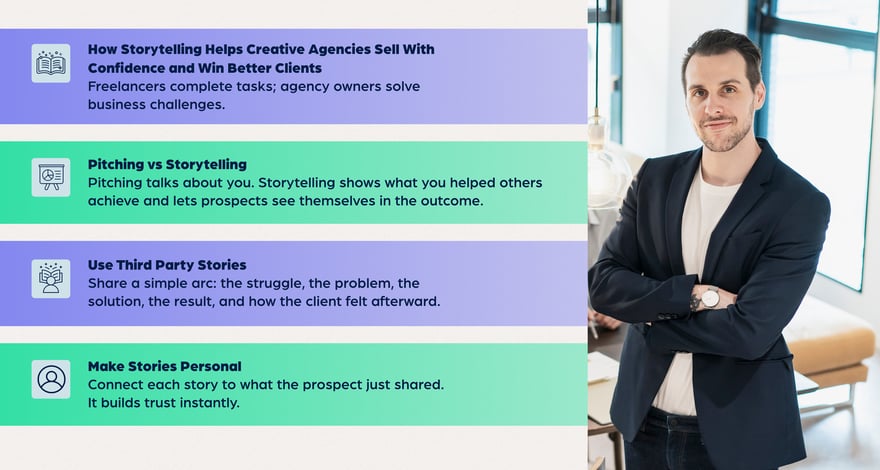
Pitching Versus Storytelling
Most agencies pitch. They walk into a meeting and start talking about themselves.
- Here is who we are
- Here is everything we offer
- Here is what makes us great
Even when the content is impressive, the experience feels one sided. It is the same feeling you get when you meet someone at a party who spends the entire conversation bragging about their accomplishments. You do not question whether they are talented. You simply do not feel drawn to them.
Storytelling creates a completely different energy. Instead of forcing an opinion of your agency onto the prospect, you let them form their own impression. When you talk about the impact you created for someone else, the prospect connects the dots on their own. They decide you are capable. They feel the transformation rather than being told to believe in it.
That shift matters because people resist being told what to think. They lean in when they are invited to make meaning for themselves.
The Third Party Selling Framework
Strategic storytelling does not happen by accident. There is a simple structure you can follow that helps you guide the prospect through a journey that mirrors their own. This is the third party selling framework.
Each story follows a clear arc:
Start with the negative emotional experience
Describe how the client felt before working with you.
- Overwhelmed
- Ignored by their previous agency
- Losing ground to competitors
- Unsure which direction to take
Connect that emotion to a concrete business problem
- Low retention
- Stalled campaigns
- Declining revenue
- Production bottlenecks
Explain the solution and the process
This is where you show your expertise without bragging. Walk through what you did and why.
- The discovery
- The decisions
- The strategy
- The nuance
- The reasoning
Share the results
Show the impact clearly and directly.
End with the emotional transformation
This is the piece people remember.
- The client now felt relieved
- They felt confident in their strategy
- They felt supported instead of overwhelmed
This structure lets the prospect experience the before and after of someone like them. It gives them a picture of the future they want and a clear sense that you are the partner who can help them reach it.
Why Context Makes Every Story More Powerful
Stories land best when they are tied directly to something the prospect just shared. Instead of forcing a story into the conversation, use their own words as the setup.
- “What you just described reminds me of a client we worked with last year who was in a very similar position.”
- “The frustration you mentioned is almost identical to where one of our clients started.”
- “When you said your team feels stretched thin, it brought up a project we guided for a client with the same challenge.”
This approach turns your stories into a natural response rather than a performance. The prospect will feel seen and understood, which is a major driver of trust. Once they recognize themselves in the story, the rest becomes easier. They start leaning toward the idea that you are the right partner long before you talk about pricing.
Why Social Proof Needs to Support Your Stories
After you help a prospect believe that the transformation is possible and that you know how to create it, the final step is validation.
This is where social proof becomes essential. It is the equivalent of checking reviews before buying a camera or reading testimonials before booking a hotel. People want confirmation that others like them have had a positive experience.
Useful forms of social proof include:
- Short testimonial videos
- Case studies written as narratives, not reports
- A clear logo wall
- Screenshots of client wins
- Direct quotes from clients
One particularly effective step is sending a tailored testimonial after the sales call. Rather than following up with a generic message, try something like:
“I know it is difficult to talk about ourselves in a way that does not sound self promotional, so instead I want to let one of our clients speak for us. Here is a short video from someone who came in with a similar challenge. I think you will appreciate hearing their experience.”
This gives your prospect the same validation they would seek on their own and keeps you from having to oversell.
Curating Your Stories Makes You More Effective
You do not need to create stories on the spot. In fact, curated stories are often more impactful. They feel spontaneous but are structured in a way that consistently builds trust.
You can prepare in advance by:
- Identifying your best five client stories
- Mapping each one to common prospect pain points
- Creating a simple visual walkthrough of each story
- Practicing the delivery so it feels conversational
Some agencies even integrate this into their creative presentations. They walk through a project step by step and share what the client experienced at each stage. The story feels personalized and natural, even though it was intentionally built.
As you get more comfortable, you will develop stories for strategy, creative, execution, and even operations. You will also create analogies, frameworks, and short examples that help clients understand the value behind your work.
Storytelling Continues Throughout the Entire Client Relationship
Storytelling does not stop once the prospect signs. Throughout the client partnership, you will continue to sell ideas, strategies, and next steps.
You will use stories to:
- Help clients visualize the future
- Explain decisions
- Create alignment
- Reduce friction
- Build confidence
- Sell the next phase of work
Even theoretical or hypothetical stories can be powerful. They give clients a way to picture a scenario without being overwhelmed by data. You are helping them feel the idea, not just understand it.
The more skilled you become at storytelling, the easier it becomes to guide clients through moments of uncertainty or hesitation.
Putting Storytelling Into Practice Inside Your Agency
If you want storytelling to become a consistent part of your sales process, you do not need to overhaul everything at once. Start by building a simple internal library of stories and examples that your entire team can use.
Begin with these steps:
- Choose five client success stories that clearly show an emotional and strategic transformation.
- Build each story using the third party selling framework.
- Identify which prospect pain points each story aligns with.
- Create short versions of each story for quick use and longer versions for deep discussions.
- Update your case studies to include emotion and narrative, not just results.
- Record two or three strong testimonial videos that reflect common challenges.
- Add a story moment directly into your sales call agenda.
When you practice these stories enough, they become second nature. You will reach for them naturally whenever a prospect shares something personal, frustrating, or aspirational.
As you start using storytelling consistently, your sales calls will shift. You will feel less pressure to impress and more ability to connect. Clients will trust you sooner. They will understand the path forward more clearly. And you will stop sounding like every other agency that leads with a list of services.
The agencies that succeed long term are the ones that know how to help prospects believe. Believe in the possibility of transformation. Believe in the path that will get them there. Believe in your ability to guide them.
Storytelling gives them that belief. It turns your pitch into an experience and your expertise into something they can feel. When you master it, you will find that closing becomes easier, relationships become stronger, and your agency stands out in a way that no capability deck ever could.