


Agency owners today are feeling the strain of two competing leadership styles that both sound good on the surface but create very different outcomes in practice. On one end is radical candor, where you care about your people as humans and still challenge them directly. On the other end is toxic positivity, where everything is always “great,” “amazing,” and “not a problem,” even when everyone can see that deadlines are slipping, clients are frustrated, and quality is inconsistent.
One side leads to trust, growth and a high performing team.
The other slowly erodes your culture while everyone smiles through clenched teeth.
If you want an agency that attracts A players, produces work you are genuinely proud of, and keeps clients returning, you cannot sit at either extreme. Silence and sugar coating will never create excellence, but neither will constant criticism delivered without care.
The real work is in the space between. A place where people feel supported and challenged, where clarity replaces confusion, and where expectations rise without resentment.
Here is what that looks like inside an agency.
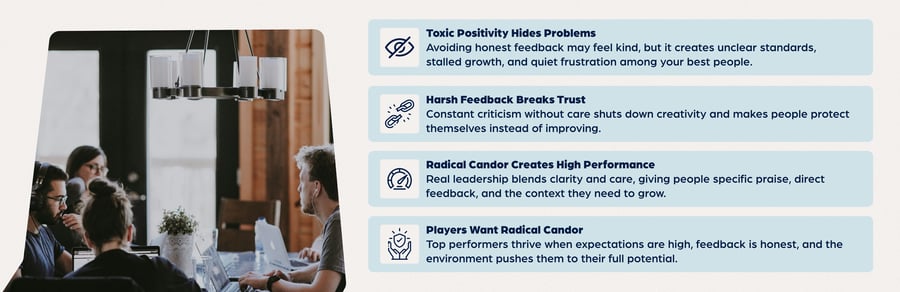
What Toxic Positivity Actually Looks Like
Toxic positivity is not optimism. Optimism acknowledges reality and chooses confidence. Toxic positivity denies reality to avoid discomfort. Inside an agency, it often shows up in moments that look gentle on the surface but create long term damage.
Examples often sound like this:
- A project blows past a deadline and the response is, “You did your best, it happens.”
- A client is clearly unhappy and the explanation becomes, “They are just high maintenance.”
- A team member keeps dropping the ball and leadership reassures them, “You have a lot going on. You are still doing great.”
These comments feel kind in the moment. They avoid conflict. They help the conversation end quickly. But underneath, they create three predictable problems.
First, no one knows where they stand. Without clarity, your team cannot tell when they are on track or far off the mark.
Second, improvement stops. If everything is always “amazing,” there is no reason to elevate skills, deepen thinking, or push the work.
Third, trust fades. Your A players see the truth. When leadership avoids it, even with good intentions, the praise begins to feel inauthentic.
Over time toxic positivity produces entitlement. Your B, C & F Team members start believing they are doing exceptional work simply because no one has ever told them otherwise. When you eventually raise expectations, it feels like punishment, not growth.
Why So Many Agency Owners Fall Into Toxic Positivity
Most agency leaders do not wake up and choose to avoid accountability. They slide into it for understandable reasons.
Fear of losing people
Hiring is exhausting. Training takes time. When you finally get someone who is “good enough,” it feels safer to keep the peace than address the gap.
Conflict avoidance
Many agency founders grew up fueled by positive reinforcement. Direct critique feels uncomfortable, so they lead others the way they themselves prefer to be led.
Pressure to deliver
When deadlines are tight, it feels faster to quietly fix the problem yourself and tell the team everything is fine rather than slow down long enough to coach.
Identity as the “nice” leader
Some owners have built an entire reputation around being encouraging and supportive. Saying, “This is not good enough,” feels like breaking character.
The longer you avoid uncomfortable moments, the more painful they become later.
The Other Extreme: When “Candor” Becomes Harmful
If toxic positivity is one extreme, there is an equally damaging one on the other side. This is the agency environment where “honesty” becomes a justification for bluntness.
Feedback is constant.
Nothing is ever quite good enough.
Wins are skimmed over, while flaws get full attention.
Corrections are delivered with an edge, sometimes in front of others.
This is not radical candor. It is pressure masked as leadership.
True radical candor requires caring personally and challenging directly. Remove the care and the challenge becomes a weapon instead of a growth tool.
When critique is relentless and care is absent:
- People stop taking risks
- Creativity shuts down
- Team members protect themselves rather than improve
- Leaders become the person people avoid, not the person they trust
And just like toxic positivity, you end up with a team that is not growing, not honest, and not confident.
What Balanced Leadership Actually Looks Like
The middle is where effective leadership lives. It is where clarity and care coexist. It is where people know what they do well and exactly what needs to change.
You do not need a complicated framework. You need three simple habits.
Acknowledge what is genuinely working
This is not about empty praise. It is about helping people understand their strengths so they can repeat them.
Try phrases like:
- “The way you opened this deck made it easy for the client to follow.”
- “You handled that pushback calmly and stayed focused on the outcome.”
- “This direction aligns well with the audience research.”
Genuine, specific recognition builds confidence and clarity.
Name what is not working
This is where many agency leaders soften so much that the message disappears. You do not need to wrap every critique in three compliments. You also do not need to make it personal.
Simply state the truth about the work or behavior.
For example:
- “This design looks good but does not solve the conversion issue we discussed.”
- “This was late and there was no proactive communication. That cannot continue.”
- “The client does not feel heard. Something was missed in discovery.”
Direct does not mean harsh. Calm clarity is the goal.
Anchor feedback in context
This step turns information into growth. Instead of saying, “Fix this,” invite the person into the thinking behind the work.
You might ask:
- “Talk me through your rationale here.”
- “Given what we know about the audience, does this still feel like the best direction?”
- “Our primary goal is qualified leads. How does this support that?”
This is how you develop judgment instead of dependence.
A Story That Shows Why People Respond Differently to Feedback
There is a moment from everyday life that perfectly illustrates how differently people respond to encouragement and critique.
One night, my spouse was working on an illustration. I said something positive about it before going to bed. Hours later, I woke up to find him still drawing at four in the morning. He told me he stayed up because my compliment inspired him.
I laughed, not at him, but at myself. Because if our roles were reversed, I would have had the opposite reaction. If he complimented my work, I might have put it away. If he told me it needed improvement, I would have obsessed over it all night.
Same situation. Same relationship. Completely different wiring.
Some people are motivated by encouragement.
Some are motivated by a challenge.
Most sit somewhere between.
Your role as a leader is not to guess perfectly. It is to recognize that people are different and that a single leadership style will not work for everyone.
If you lean only on positivity, you will lose the people who want a higher bar.
If you lean only on critique, you will overwhelm the people who need fuel more than friction.
Your team needs both.
How Toxic Positivity Creates Stagnation
To see how damaging long term positivity can be, consider a real scenario many agencies face.
There is an agency where deadlines slip regularly. Client feedback is softened before being handed to the team. Performance issues are reframed as stress, fit, or circumstance. Leadership avoids hard truths to keep the culture “friendly.”
Here is what quietly happens.
Standards become unclear
The difference between “fine” and “excellent” disappears.
Ownership weakens
People explain, defend, and redirect rather than take responsibility.
Change becomes painful
Raising expectations feels like betrayal to a team that was told everything was great for years.
A players become frustrated
Your strongest people silently disengage or leave because the environment will not stretch them.
Leadership starts walking on eggshells
Managers fear upsetting their team more than delivering great work.
What started as kindness becomes a long term limitation. The agency stays stuck because no one can say what needs to be said.
Why Your Best People Want Radical Candor
It is easy to overestimate how fragile your team is and underestimate how much your top performers want accountability. The people you most want to keep long term are the ones who want clarity, higher standards and opportunities to grow.
A players want:
- To know exactly where they stand.
- To be held to a clear standard.
- To understand how to improve quickly.
- To work alongside others who are growing.
When you withhold real feedback to protect them, you are not protecting them. You are stalling their development. You are keeping them from the information they need to become excellent.
They may not tell you directly. They may say they are leaving for money, a new challenge, or timing. But very often the truth is simpler. They outgrew the environment.
And when chronic underperformance goes unaddressed, your best people carry the cost. They fix mistakes, manage client tension, and stay late to compensate. Over time that erodes respect far more than any difficult conversation ever would.
Radical candor is not about being brutally honest. It is about creating the environment that allows your best people to thrive.
Choosing Growth Over Comfort
You cannot build a strong, profitable agency on fake harmony or constant critique. Toxic positivity keeps people comfortable and stuck. Harshness keeps people anxious and defensive. Radical candor lives in the middle.
It sounds like this:
“I appreciate how much effort you put into this, and here are the areas we need to improve.”
“You handled that call well, and next time I want you to set boundaries earlier.”
“You are capable of more, and this result does not reflect your ability.”
When you lead this way consistently:
- Expectations become clear.
- Strengths become visible.
- Growth edges become actionable.
- Team members feel supported and stretched.
- Clients feel the improvement in the work.
You do not need to change your personality. You simply need to choose something more important than momentary comfort.
Some days it will feel easier to smile and say, “It is fine.” Some days it will feel tempting to unload your frustration and call it honesty. Those are the moments that define the culture you build.
The question is simple. Do you want to protect feelings for a moment, or protect growth for the long term? Do you want an agency that feels nice, or an agency that becomes excellent?
When you consistently choose growth and pair it with genuine care, your team does not just do their job. They do the best work of their careers, together.