
Most agency owners share a trait that has served them well since day one. You move fast. You trust your instincts. You see an opportunity and jump toward it with energy and conviction. This instinct is part of why your agency exists at all. In the early stages, it keeps you alive. You secure clients, adapt quickly to changing needs, and take bold action when others hesitate. That momentum is powerful.
But as your agency grows, that same instinct can quietly begin working against you. What once helped you accelerate now contributes to overcomplication, margin erosion, and unnecessary pressure. Many agencies do not struggle because they lack demand or clients. They struggle because they are trying to scale on a model that was only ever meant for survival, not sustainability.
This outdated mindset leads to two predictable outcomes that keep agencies stuck:
- Hiring too many people too quickly.
- Delivering far more work than clients are paying for.
On the surface, both actions feel justified. They feel responsible. They feel client centric. Yet behind the scenes, both drain profitability, overwhelm your team, and make growth feel heavier than it needs to be. Sustainable growth requires a shift away from instinct and toward insight. The goal is not to lose your entrepreneurial drive but to direct that drive with clarity.
The Instinct Behind Over hiring
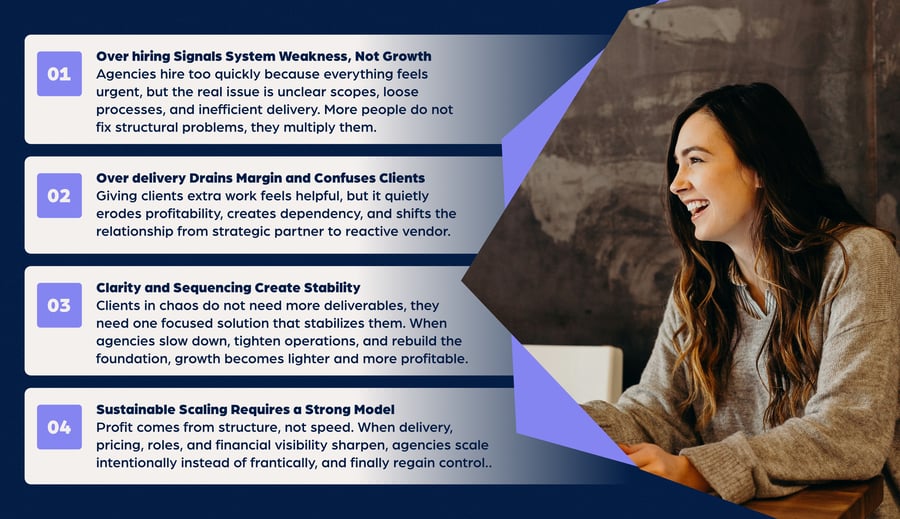
Most agency owners do not wake up and decide to over hire. It happens slowly, often without clear awareness until payroll starts to outweigh revenue. A few large projects land at the same time. A client expands their scope. A busy season hits unexpectedly. The team feels stretched, and the pressure intensifies. The quick fix feels straightforward. Hire someone NOW.
The issue is not hiring itself. The issue is what you assume will happen after the hire. Many owners assume:
- The current workload will remain consistent.
- More people automatically mean more capacity.
- The existing delivery system can absorb more work without strain.
- Immediate relief is worth any short term cost.
But most agencies discover that their capacity challenges are typically not about headcount. They were about clarity.
When scopes are loose, processes are inconsistent, and boundaries are unclear, the workload feels heavier than it truly is. In that environment, every new hire inherits the inefficiencies. They step into unclear expectations, inconsistent processes, and a delivery model that depends on heroics rather than structure. What happens next is predictable. The team grows, but the problems remain, only now they are more expensive.
A strong agency does not relieve pressure by adding more people. It relieves pressure by tightening the structure around the people it already has. When operations are clear, a smaller team produces higher quality work with more consistency and far less stress.
Then hire when they see a true resource gap based on insights not gut instinct.
The Over delivery Habit That Looks Helpful But Hurts Your Agency
If over hiring comes from internal pressure, over delivery comes from external pressure. You want your clients to succeed. You want them to feel supported. You want to avoid risk, conflict, or uncertainty. So when a client becomes overwhelmed or unhappy, your instinct is to solve the problem immediately by giving more.
This often looks like:
- Extra deliverables.
- Additional time.
- More revisions.
- More ideas and strategy.
- More communication and access.
It feels generous, but generosity without boundaries creates long term damage.
Over delivery leads to:
- Clients unknowingly expecting more than they paid for.
- A blurred definition of success.
- A team that is overworked and under supported.
- Quiet margin erosion that compounds every month.
- A client relationship built on volume instead of strategic value.
Over delivery does not make clients happier. It makes them emboldened. It shifts the relationship from strategic to reactive. It signals that your time and expertise are flexible instead of valuable. And ultimately, it positions you as a vendor instead of a partner.
Many agency owners believe that giving more will secure long term loyalty. In reality, it trains clients to undervalue your work.
The Buoy Analogy That Changes How You Serve Clients
Imagine you are on a boat. Someone who cannot swim falls into the water. They are panicking. They are sinking. They cannot hear you. They cannot focus. In that moment, they need one thing: a buoy.
They do not need:
- A detailed plan for how to swim.
- Guidance on technique.
- A lecture about safety.
- Multiple potential options.
They need the one action that keeps them alive long enough to regain stability.
Agencies often forget this principle. When a client is overwhelmed, agencies throw everything at them. More deliverables, more advice, more platforms, more creative assets. But a client in distress cannot process complexity. They need clarity. They need focus. They need the one solution that will create stability.
Once they are stable, they can receive more direction. They can learn the next step. They can follow a more strategic plan. But without the buoy, none of that matters.
This is why sequencing matters. Strategic delivery is not about how much you can do. It is about doing the right thing at the right time.
Why Slowing Down Can Accelerate Your Growth
Creative Agency Success supported a client who arrived with urgency. She had big goals. She wanted rapid revenue expansion. She wanted to scale aggressively. She wanted growth immediately. But her agency was not ready.
Her margins were weak. Her pricing was inconsistent. Her delivery process was bloated. Her team was strained. Her financial visibility was limited. Scaling under those conditions would not create success. It would accelerate the chaos.
So we slowed down. We rebuilt the foundation before pursuing growth.
That meant:
- Cleaning up delivery and eliminating inefficiencies.
- Improving pricing to reflect actual value.
- Reducing scope creep across all accounts.
- Increasing operational clarity and role definition.
- Creating financial visibility so decisions were informed, not emotional.
At first, she resisted the slowdown. Many agency owners do. But once the new foundation was in place, the agency became lighter. The team became more efficient. Clients received clearer, more focused value. The business finally felt in control.
Over the next year, revenue grew at a healthy pace. But the real win was profit. Her net profit increased more than four times. And because the foundation was strong, she finally had the freedom to grow intentionally instead of frantically.
The agencies that grow sustainably are the ones willing to slow down long enough to stabilize the engine that carries their growth.
The Financial Fundamentals Most Owners Avoid
Numbers can feel intimidating for creative leaders. Many agency owners describe themselves as “not a numbers person.” But basic financial literacy is essential if you want to grow sustainably. You do not need to become a CFO, but you do need to understand a few benchmarks that signal whether your agency is healthy.
A financially sound agency typically has:
- At least 50% gross profitability.
- Roughly 20% to 30% operational costs.
- At least 20% net profit after paying the owner fairly.
If your numbers fall below these ranges, more revenue will not solve the issue. Additional clients will not solve the issue. More headcount will not solve the issue. Only improving your model will.
Avoiding numbers does not protect you. It blinds you. And when you cannot see warning signs early, the problems become more expensive to solve.
The Hidden Risk of Over delivery
Over delivery often feels like you are protecting the client relationship, but it can weaken it. When clients become accustomed to extra work at no cost, they stop recognizing the value of your time. They begin to measure your contribution by how much you do instead of the quality of what you deliver.
This quietly creates:
- Misaligned expectations.
- Frustration during scope conversations.
- Tension when you try to raise prices.
- Team burnout.
- Reduced margin and cash flow instability.
You can deliver an exceptional client experience without drowning clients in deliverables. The most impactful agencies focus on the minimum effective solution that drives the highest return. When your work is focused and strategic, clients trust you more and results improve.
Excellence comes from clarity. Not excess.
Building the Foundation Before You Scale
Your agency is like a house. You would never build a second story without reinforcing the foundation. Yet agencies attempt this all the time. When delivery is inconsistent, scaling magnifies the inconsistency. When boundaries are unclear, scaling magnifies the confusion. When margins are weak, scaling magnifies the financial strain.
Before you scale, strengthen:
- Delivery systems.
- Pricing strategy.
- Role clarity.
- Operational processes.
- Financial visibility.
When those pieces are solid, growth becomes significantly lighter.
Scaling With Intention
Agencies rarely struggle due to a lack of opportunity. They struggle because they operate on instinct instead of insight. When you shift that dynamic:
- Margin improves.
- Delivery becomes predictable.
- Team stress decreases.
- Clients receive focused, high quality work.
- Growth becomes intentional, not chaotic.
You do not need to hire your way out of pressure. You need a stronger model. You do not need more deliverables. You need more clarity. When you build the right foundation, scaling becomes a choice rather than a burden.
This is how you grow sustainably. This is how profitability becomes predictable. And this is how you build an agency that supports your life instead of consuming it.