


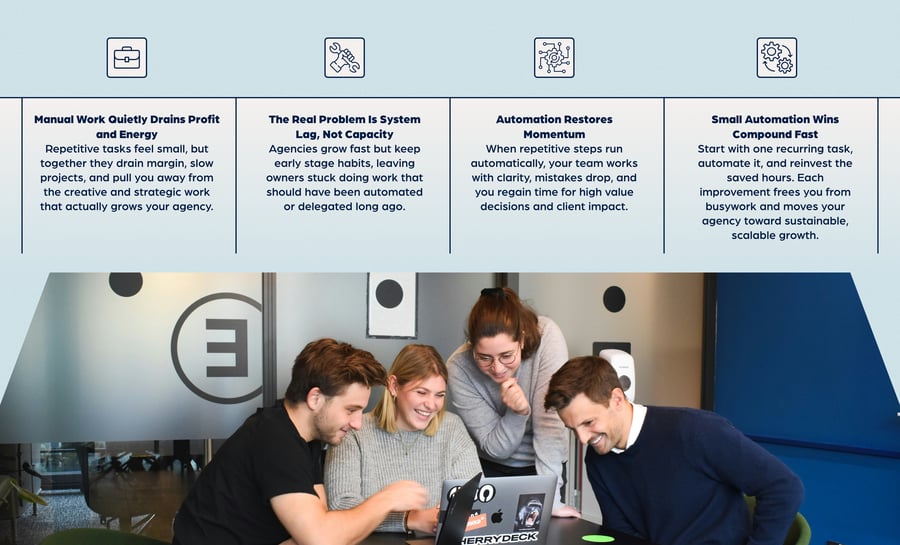
Most agency owners reach a point where their days feel heavier than they should. Not because the work itself is hard, but because the systems behind the work have never evolved. What begins as a few quick manual steps early in the agency’s life eventually becomes routine. Folder creation. Rebuilding templates. Naming files. Moving assets. Sending invoices. Copying data between platforms. Repeating the same steps again and again.
Individually these tasks appear harmless. Taken together they quietly drain your energy, chip away at your margins, and slowly separate you from the creative and strategic work that once made you excited about your business. The worst part is that these small inefficiencies begin to feel normal. They blend into the background. They feel like part of the job.
But manual work is not simply inconvenient. It is one of the most expensive and underestimated drains inside an agency. It impacts your ability to grow, your team’s ability to thrive, and your own ability to lead with clarity and excitement. We see this pattern often. Owners describe feeling pulled into low value work they never intended to take on. Many know their systems could be better, but they cannot see a path to improving them with everything already on their plate.
This is the point where momentum stalls. Not because the agency lacks potential, but because the owner is carrying hidden weight they were never meant to hold.
The Patterns That Keep Manual Work Alive
Agency owners rarely hold on to manual work intentionally. The reasons feel logical at first. It feels easier to handle tasks yourself instead of slowing down to document or automate them. You know where everything is. You understand the tools. You can do the process fast enough that training someone else feels inefficient.
It is also natural to think:
- I will automate this when things calm down.
- It is faster if I just handle it.
- This task is too specific to hand off.
- I do not have time to figure out the tech.
These thoughts create a trap. Not a dramatic one, but a quiet one. A slow one. The kind that erodes your capacity one small step at a time. Before long, the owner becomes the bottleneck in every process. Manual tasks fill the day. The team relies on the owner’s knowledge. Projects expand because small details fall through the cracks. Stress rises.
What once felt faster becomes the reason you do not have time for the work that matters most.
The Exercise That Reveals the Truth About Your Systems
There is a simple way to see how much of your day depends on manual effort. Imagine you cannot use your keyboard for a full day. You can click, drag, talk to your computer, or use voice to text. You just cannot type.
What disappears instantly?
- Copying information between platforms.
- Naming and organizing assets.
- Creating folders and directory structures.
- Sending repetitive messages.
- Generating invoices.
- Rebuilding onboarding or invoicing steps.
What remains intact is the work that requires your perspective. Strategy. Creative direction. Client conversations. Leadership. Decisions. Coaching. Ideas. These are the moments where an agency owner makes their highest contribution. They are also the activities that fuel excitement, momentum, and confidence.
Everything else becomes a signal. If a task falls apart when you remove the keyboard, it is likely a task that never should have required you in the first place. That is where automation begins.
Why Agencies Lose Momentum From Manual Work
Agencies rarely start with structured systems. They start in survival mode. You take on clients, deliver great work, build relationships, and handle every detail yourself. It works. At first.
Then you add a few more clients. You add team members. You add tools. You add responsibilities. The volume increases but the systems do not evolve at the same pace.
Soon every new project means:
- New folders that must be created in a specific structure
- Templates that must be duplicated and renamed
- Invoices rebuilt from scratch
- New tasks recreated inside your project system
- Files named differently depending on who is doing the work
Even if you have good people, they end up spending too much time on repetitive steps that do not require their skill. A designer doing administrative tasks is not designing. A strategist exporting spreadsheets is not strategizing. A project manager chasing files is not managing the project.
And when these things fall back onto the owner, it becomes even more expensive. Owners often work late into the night because the small stuff never stops. They end up constantly catching up instead of moving the agency forward. Creativity fades. Energy drops. Problems grow.
One client told us recently that she used to feel excited every morning to start her client work. After a few years, she began to feel dread instead. Not because she disliked the work, but because she knew that half her day would be consumed by tasks that had nothing to do with her actual strengths.
Manual work is not harmless. It is a tax. And you pay that tax every day.
How Automation Gives Your Agency Its Momentum Back
Automation does not replace people. It removes waste. It clears the noise. It gives your team the freedom to work at their best. It gives you the freedom to be the leader your agency needs.
Automation turns repetitive steps into repeatable systems. When a new client closes, folders can be created instantly. Contract templates can be populated. Tasks can be assigned automatically. Permissions can be added. Invoices can be generated. Files can be named according to a standard.
Imagine what your day looks like when all of that happens without you.
Automation creates consistency. And consistency creates confidence. Your team knows exactly where things are. They know what to do next. They operate with fewer questions and fewer mistakes. You stop hovering. You stop worrying about the details. You start thinking like a CEO again.
AI expands this even further. It does not replace your thinking. It speeds up the parts of your work that do not require deep judgment. It can summarize research, organize information, draft first versions of content, prepare data, and turn messy inputs into structured insights. You and your team stay focused on interpretation and direction, not assembly.
Automation and AI together remove the weight that keeps agencies stuck in busywork instead of progress.
The Hidden Financial Impact That Most Owners Miss
Manual work is expensive in ways that are often overlooked. It consumes hours that should be billable. It pushes projects behind schedule. It delays invoices. It forces high skill team members to perform low skill tasks. All of this erodes profitability.
We worked with a client who discovered she was spending more than seven hours each week on onboarding tasks. None of these hours were strategic. None generated revenue. After building a simple automated onboarding workflow, she eliminated almost all of those hours. Instead of losing seven hours per week, she gained seven hours of strategic time. That change alone increased her billable capacity by more than 350 hours per year.
That is the power of removing manual inefficiency. It gives you back time you can reinvest into creative development, leadership, client strategy, sales conversations, and high value decision making. These are the activities that grow an agency sustainably.
You Might Already Be Behind Without Realizing It
Automation is not new. Tools like Zapier have existed for years. Many project management platforms offer built in automation. Finance tools automate recurring invoicing and reporting. Yet many agencies still handle these steps manually.
This creates a widening gap between agencies that lean into automation and those that postpone it. Agencies that automate early build cleaner systems, train their teams faster, and adopt AI more effectively. Agencies that delay continue operating with outdated processes without realizing how much time and profit they are losing.
When AI becomes more powerful and accessible, agencies with clean systems will benefit the fastest. Those without foundational organization will struggle because AI reflects whatever chaos it is given. Clean systems today are what unlock competitive advantage tomorrow.
How to Put Automation in Place This Month
You do not need to overhaul everything at once. You simply need a starting point. Begin with small, manageable steps such as:
- Identify a few manual tasks that consume your time each week.
- Outline the basic steps involved in completing each task.
- Highlight which steps do not require human decision making.
- Choose one of these tasks to automate first. Use a simple automation tool or delegate the implementation to someone who enjoys operations.
- Reinvest the time you save into planning additional improvements.
Small steps make a measurable difference. Every automated task reduces friction, restores energy, and frees you to focus on the work that matters most. That is how momentum returns.
You did not start your agency to become a file mover, a task manager, or a human bridge between tools. You started it to make an impact. Automation gives you back the space to lead, create, and build an agency that serves your life instead of consuming it.