


How Elite Creative Agencies Grow With Fewer, Better Team Members
At some point, almost every creative agency hits the same wall. Projects are coming in, the team feels stretched, and the most obvious solution seems to be hiring. Another designer. Another strategist. Another account manager.
On paper, it makes sense. More people should equal more output.
In reality, that is rarely how it plays out.
Instead of momentum, agencies often experience more meetings, slower decisions, higher payroll, and shrinking margins. The business feels heavier, not healthier. Growth becomes harder to manage, not easier.
The truth is this. More people do not automatically create more output. In many cases, they create more complexity.
The most profitable and well-run creative agencies understand this. They do not grow sustainably by stacking headcount. They grow by increasing talent density and building systems that allow a small group of exceptional people to do their best work.
In this post, we are breaking down how elite agencies build high-performing teams without hiring more people, why bigger teams often reduce output, and how you can apply the same structure inside your agency.
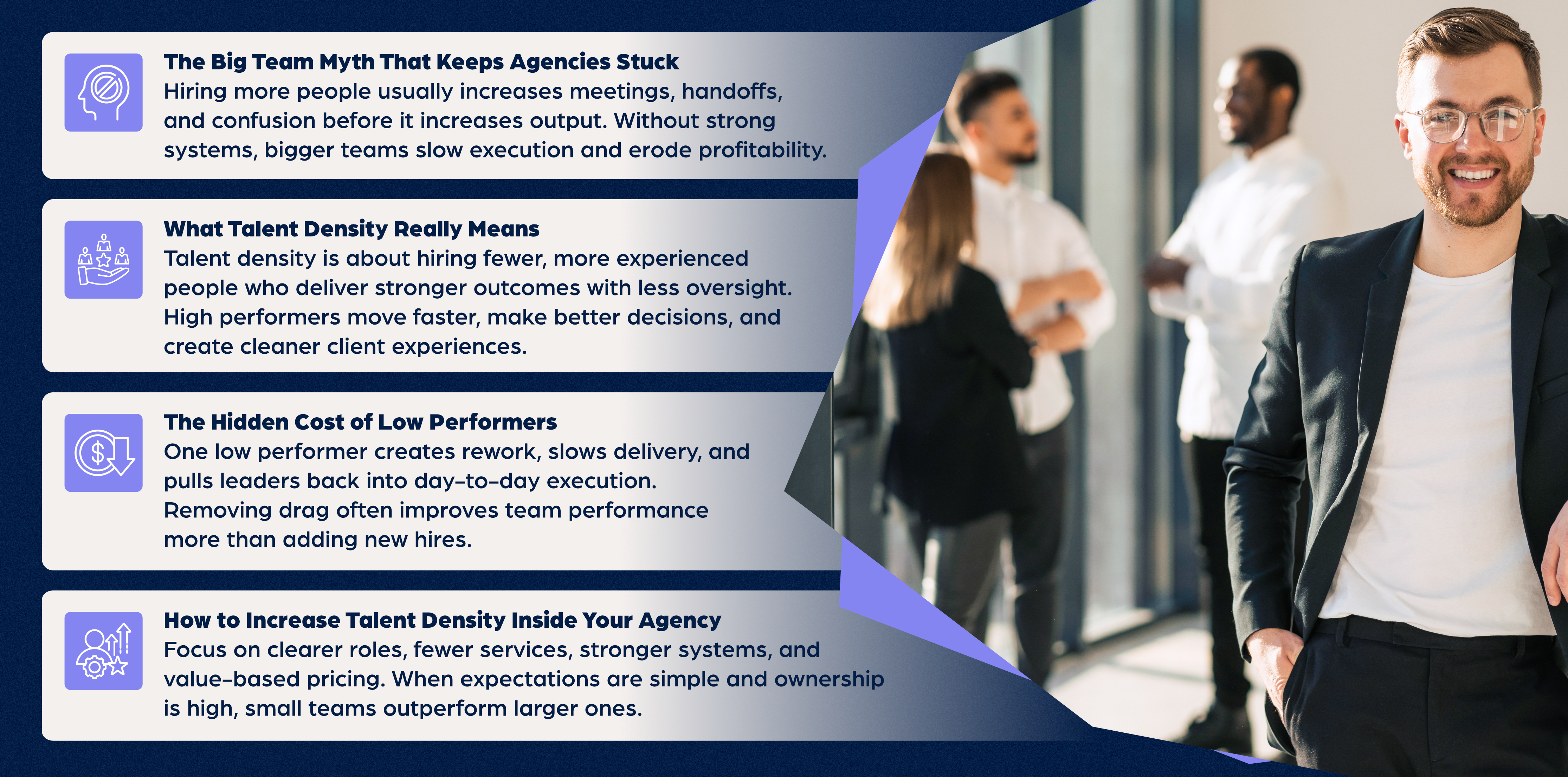
The Big Team Myth That Keeps Agencies Stuck
Many agency owners operate under an unspoken belief that bigger teams are better teams. That belief quietly drives hiring decisions, pricing pressure, and operational overwhelm.
What actually happens as teams grow is more communication lines. More handoffs. More meetings. More approvals. More management.
Every additional hire increases the number of ways things can slow down or break. Simple projects require more coordination. Information gets diluted. Accountability gets fuzzy. And the founder often becomes the bottleneck again, this time as the manager instead of the creative.
Large teams are not inherently bad, but they demand significant operational infrastructure to work well. More SOPs. More communication frameworks. More clarity around roles, responsibilities, and expectations.
That infrastructure takes time to build and even longer to refine. Until it is solid, larger teams tend to be expensive, slow, and surprisingly fragile.
Smaller senior-led teams operate very differently. With fewer communication paths and clearer ownership, they move faster and require less process to function well. When paired with value-based pricing, they are often more profitable and far more sustainable.
This is not the right model for every agency. If your business relies on high-volume, deliverable-based services at lower price points, this structure may not fit. But for agencies selling strategy, creativity, and outcomes, it is often the model that unlocks the next level.
What Talent Density Really Means
Talent density is not about doing more with less. It is about doing better with fewer, stronger people.
High talent density teams are built around individuals who bring deep experience, strong judgment, and full ownership of their role. These are people who have done the work hundreds of times before. They understand scope instinctively. They communicate clearly with clients. They make smart decisions without constant oversight.
When talent density is high, teams experience faster execution, fewer blockers, stronger creative thinking, higher morale, and deeper accountability. The work feels cleaner. The delivery rhythm stabilizes. And the agency stops relying on heroics to get projects across the finish line.
This model works best when people are operating in their zone of genius. The more focused your services and the clearer your ideal client profile, the easier it becomes to build and sustain this kind of team.
The Hidden Cost of Low Performers
One of the biggest drags on agency performance is not a lack of talent. It is holding onto the wrong talent.
A single low performer can quietly undermine the entire team. They create rework for high performers. They increase oversight and management time. They slow down delivery. They pull founders back into execution. They reduce trust internally and externally.
In many agencies, removing one low performer improves output more than hiring two new people. This is true across most service-based businesses, but it is especially true in agencies where delivery quality and speed directly impact profitability.
The people you hold onto out of loyalty, fear, or convenience are often the ones holding your agency back in meaningful ways. They drain your energy and prevent your best people from doing their best work.
How Elite Agencies Hire Differently
High-performing agencies do not hire quickly. They hire deliberately.
They test for taste, judgment, speed, ownership, and communication. They care less about resumes and more about how people actually think and operate.
Many start with contractor relationships before moving to full-time roles. This creates flexibility and allows performance to be evaluated in real conditions. Lower performers are removed quickly and intentionally, protecting the standards of the team.
But hiring great people is only part of the equation. Without the right systems, even elite talent will struggle.
The Systems That Make Senior Teams Work
Talent density only works when supported by strong foundational systems. Senior teams do not need micromanagement. They need clarity.
That starts with clean handoffs from sales to delivery. Pricing, scope, and expectations must be clearly defined and communicated. When this breaks down, founders get pulled back in to fix misunderstandings and reset client relationships.
Elite agencies invest in clear scopes of work, defined roles and responsibilities, strong project management visibility, and simple communication frameworks. These systems are not about bureaucracy. They exist to eliminate rework and reduce dependency on the founder.
High performers thrive when expectations are clear and success is measurable. They want ownership. They want autonomy. They want to win.
Why Senior Teams Outperform Bloated Organizations
Senior team-based agencies structure themselves differently. They hire creatives, strategists, and account leaders with deep specialty skills. They avoid bloated org charts. They minimize middle management. They reduce unnecessary meetings.
Instead of focusing on headcount, they focus on leverage.
They sell value, not time. They price based on outcomes, not hours. This changes everything.
When pricing is aligned with value, senior teams can produce extraordinary results without burning out. Margins increase because the cost of delivery is no longer tied directly to time spent. Quality improves because the environment is optimized for high performance.
The agency becomes lighter, faster, and more resilient.
How to Increase Talent Density Inside Your Agency
You do not need to rebuild your agency overnight to move in this direction. Start with a few focused changes.
First, get clear on the roles you actually need to support your current services. Many agencies are overextended because they offer too much to too many people.
Second, address low performance directly. Protect your best people by removing the drag.
Third, upgrade your systems. Sales, pricing, scoping, and delivery must communicate seamlessly. This is what removes founder dependency.
Fourth, shift toward value-based pricing. This model does not work when everything is sold as deliverables or hours.
Fifth, simplify internal approvals and communication. Reduce friction wherever possible.
Finally, automate repetitive work. Senior talent does not want to spend time on administrative tasks. They want autonomy, ownership, and meaningful work. Let them run.
How to Implement This Without Breaking Your Agency
Start by auditing your current team and delivery process. Identify where complexity has crept in and where rework is happening. Look closely at who is creating leverage and who is creating drag.
Tighten your service offerings so your team can specialize. Clarify scopes and success metrics so expectations are simple and strong. Invest in systems that remove you as the bottleneck instead of pulling you back in.
Building an elite team does not require more people. It requires the right people in the right roles inside a system that enables high performance.
When talent density is high, speed increases, quality improves, margins expand, and morale rises. The agency becomes sustainable. And you get to lead instead of constantly putting out fires.