


There is a lot of noise right now about whether creative agencies will even exist in a few years.
AI tools are improving at a pace that feels almost impossible to keep up with. Clients expect more output in less time. Content velocity has exploded across every channel. And new agencies seem to appear overnight, all promising faster turnaround, lower costs, and smarter automation.
So it is fair to ask the question many agency owners are quietly wrestling with.
In 2026, will creative agencies still be worth it, or is the industry becoming a dead business?
Here is the truth that cuts through the noise.
Creative agencies are not dying. Bad or mediocre agencies are becoming obsolete.
What we are witnessing is not the collapse of the agency model. It is an evolution. And like every major shift before it, this one is exposing weak foundations while rewarding those who adapt early.
The agencies that are struggling right now are not losing because AI exists. They are losing because the way they operate no longer matches the reality of the market. The agencies that are growing are not fighting the future. They are redesigning themselves around it.
This is not about working harder, adding more services, or chasing trends. It is about clarity, systems, and leadership.
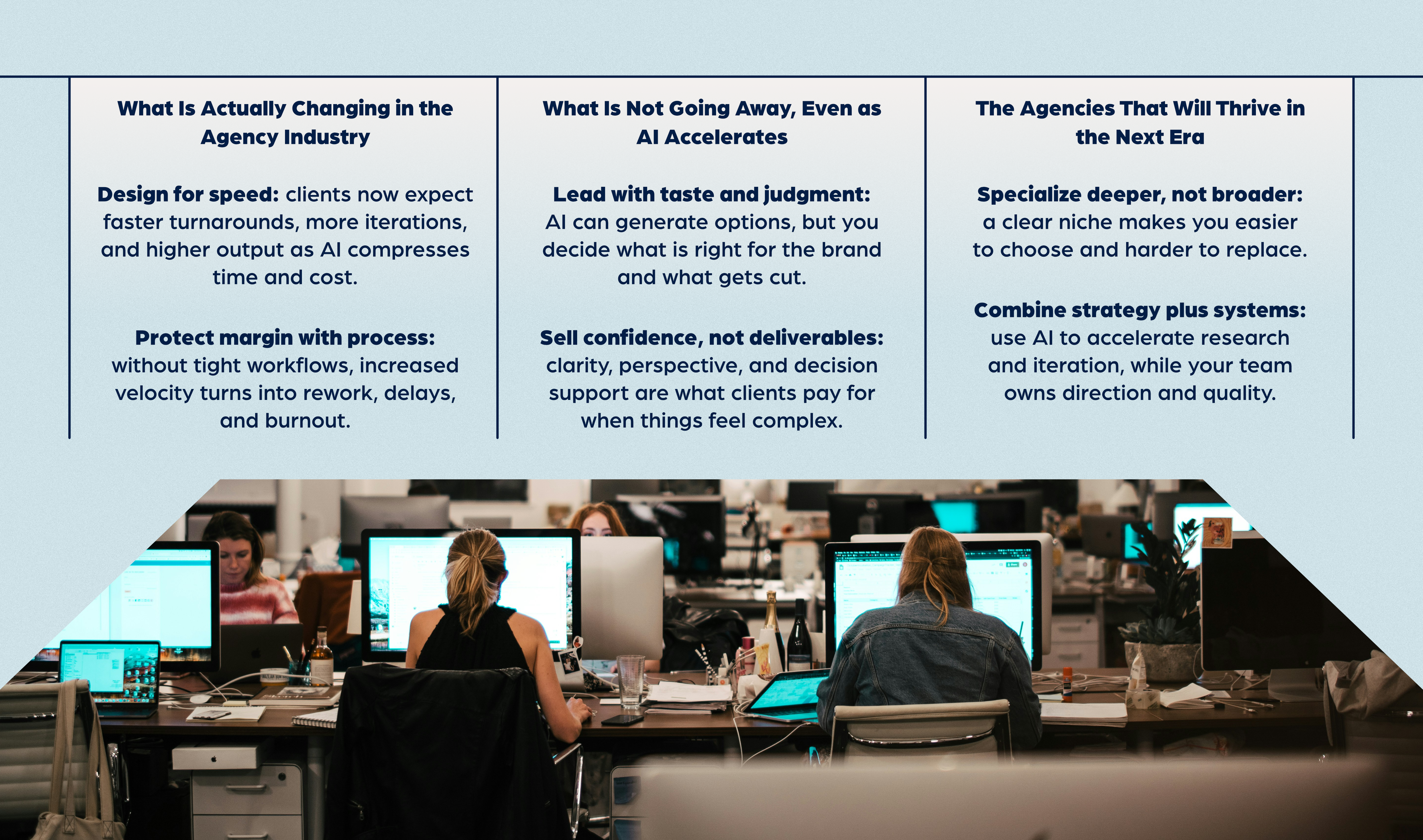
What Is Actually Changing in the Agency Industry
The most important thing to understand is that the changes reshaping agencies are not hypothetical. They are already here, and they are accelerating.
Content creation has fundamentally changed. What once required large teams and long timelines can now be generated in hours. Research, ideation, first drafts, and iterations happen faster than ever. As a result, the perceived cost and time associated with execution has dropped dramatically.
Clients feel this shift, even if they cannot articulate it clearly. They expect:
- Faster turnaround
- More frequent iteration
- Shorter feedback cycles
- Clearer visibility into progress
At the same time, content velocity has become the baseline. Brands are publishing across more platforms, in more formats, with higher frequency. Agencies that were built for slower, campaign-based delivery are feeling pressure at every step.
Without strong systems, this demand creates chaos. Timelines slip. Revisions pile up. Teams operate in constant reaction mode. Margins erode not because pricing is wrong, but because delivery is inefficient.
Layer on top of that the rise of in-house creative teams and global competition. Many brands are bringing execution closer internally, while others are outsourcing production to lower-cost providers. Certain deliverables are becoming commoditized whether agencies like it or not.
This does not mean agencies are unnecessary. It means execution alone is no longer the value.
The value has moved upstream.
What Is Not Going Away, Even as AI Accelerates
While many agency owners fixate on what AI can do, fewer are paying attention to what it cannot.
And this is where the real opportunity lives.
AI does not replace understanding. It does not replace judgment. It does not replace experience.
Clients are not just buying output. They are buying confidence. Confidence that they are making the right decisions. Confidence that their brand is being handled with care. Confidence that someone sees the bigger picture when they cannot.
There are several areas where agencies are becoming more valuable, not less.
Human connection and emotional intelligence matter more as business becomes more automated. Clients want partners who understand nuance, context, and internal dynamics. They want someone who can read the room, not just the brief.
Taste remains irreplaceable. Knowing what to cut is often more important than knowing what to create. Taste is built through years of exposure, pattern recognition, and lived experience. It is not just data-driven. It is judgment-driven.
Strategy and perspective are increasingly scarce. AI responds to prompts. It does not define priorities. Many clients are overwhelmed with tools and options but lack clarity on what actually matters. Agencies that can bring focus and direction create immense relief.
Institutional knowledge compounds. Agencies that have seen patterns across dozens or hundreds of clients develop instincts that tools cannot replicate. Knowing “if this, then that” is a competitive advantage that grows over time.
Cross-channel thinking remains complex. Businesses do not operate in silos. Agencies that understand how brand, messaging, content, and systems connect create cohesion that isolated tools cannot produce.
Agency value is not disappearing. It is concentrating around insight, leadership, and clarity.
Why Some Agency Models Are Struggling So Much Right Now
The agencies experiencing the most pain tend to share similar characteristics.
The generalist agency that does everything struggles to stand out in a crowded market. Broad positioning worked when competition was limited. Today, it blends into the background. When everyone claims to do the same things, price becomes the differentiator by default.
Agencies without systems feel slower than their competitors. When delivery relies on tribal knowledge, hero employees, or constant improvisation, speed suffers. As expectations rise, these agencies burn out their teams and erode profitability.
Pure execution-only agencies are directly exposed to automation and global labor markets. If the primary value is “build what the client asks for,” that work becomes interchangeable. Clients will always look for faster and cheaper options.
Agencies without depth or perspective create friction. As markets become more complex, clients have less tolerance for ambiguity. They want guidance, not just output. Agencies that cannot lead conversations struggle to retain trust.
None of these agencies are failing because they lack talent. They are failing because their structure no longer matches how value is perceived.
The Agencies That Will Thrive in the Next Era
The agencies positioned to grow are not doing more. They are doing less, better.
They combine creativity with systems. Clear workflows, defined delivery rhythms, and intentional use of AI allow teams to move faster without sacrificing quality. Systems do not limit creativity. They remove friction so creativity can thrive.
They specialize deeply. Instead of serving everyone, they own a narrow segment with precision. When you understand a specific market deeply, your work improves, your messaging sharpens, and your sales cycle shortens. Serving just 1 percent of the right market is often enough to build a highly profitable agency.
They lead as strategic creative partners. Strategy and creative direction are not add-ons. They are the foundation. AI becomes a tool for acceleration, not a threat to relevance.
They prioritize operational clarity. Clear offers, clear frameworks, and predictable execution create trust. Clients do not just want speed. They want assurance that things will not fall apart.
They build and protect institutional knowledge. Documented experience becomes a moat. Over time, this creates consistency for teams and confidence for clients.
The winners operate like creative systems, not collections of talent.
The Three Pillars That Consistently Separate Strong Agencies from Struggling Ones
Across hundreds of agencies, three pillars show up again and again as the difference between chaos and control.
Clarity is first. Clear positioning, a defined niche, and a specific outcome reduce friction everywhere. Marketing becomes easier. Sales conversations become shorter. Delivery becomes more repeatable.
Velocity comes next. Not rushing, but removing friction. Shorter feedback loops, defined workflows, and clear handoffs allow agencies to keep pace without burning out their teams.
Experience remains the ultimate differentiator. Taste, strategy, and pattern recognition cannot be automated. Agencies that lead with experience build trust that compounds over time.
When these three pillars work together, agencies become resilient instead of reactive.
What Agency Owners Need to Implement Now
Understanding the shift is only valuable if it leads to action.
The first step is tightening your niche. Most agencies do not need more leads. They need better alignment. Ask yourself whether serving only clients who can afford your ideal pricing and those that you know that you can help would still support your goals. In most cases, it would.
Next, invest in systems that support both speed and quality. Document workflows. Define delivery rhythms. Reduce decision fatigue for your team. Systems are not bureaucracy. They are leverage.
Anchor your offer in strategy and direction. Execution is expected. Insight is valued. Make creative direction and clarity core to what you sell.
Use AI intentionally as a force multiplier. Accelerate research, exploration, and iteration, but never outsource judgment or perspective. The agencies that win will blend human insight with intelligent automation.
Finally, operate with clear rhythms. When teams know how work flows, what success looks like, and where decisions live, performance improves across the board.
How to Apply This Going Forward
The agency industry is not disappearing. It is growing up.
The future will be more competitive and less forgiving of chaos. Commoditization will increase at the execution level. Expectations will continue to rise.
But the agencies that adapt will not just survive. They will grow faster, operate with more confidence, and reclaim control of their time and margins.
Creative agencies still matter because they understand people. They understand emotion, story, and connection in ways tools cannot.
AI accelerates creation, but it does not replace understanding.
If you build your agency around clarity, velocity, and experience, you are not preparing to survive 2026. You are positioning yourself to lead it.