
If you run a creative agency, decision fatigue is probably not an abstract idea. It is your daily reality.
Client strategy, pricing, hiring, scope changes, tools, operations, fire drills. Somewhere along the way, every path in the business started leading back to you. At first, it felt like leadership. Over time, it starts to feel like pressure.
You notice that:
- Simple choices feel heavier than they should.
- You delay decisions because your brain is tired, not because you need more data.
- Projects stall while your team waits for your response.
- By the time you get home, the thought of deciding what to eat for dinner feels like too much.
That is decision fatigue. And for agency owners, it is not just inconvenient. It reduces speed, weakens judgment, and quietly caps your growth.
The good news is that this is not a permanent condition. It is a systems problem. You trained your agency, often unintentionally, to send everything to you. Which means you can retrain it.
In this article, we will walk through practical ways to:
- Reduce your decision load without losing visibility.
- Train your team to bring solutions, not just problems.
- Use risk to decide which decisions you still need to own.
- Shift your role from primary problem solver to final decision maker.
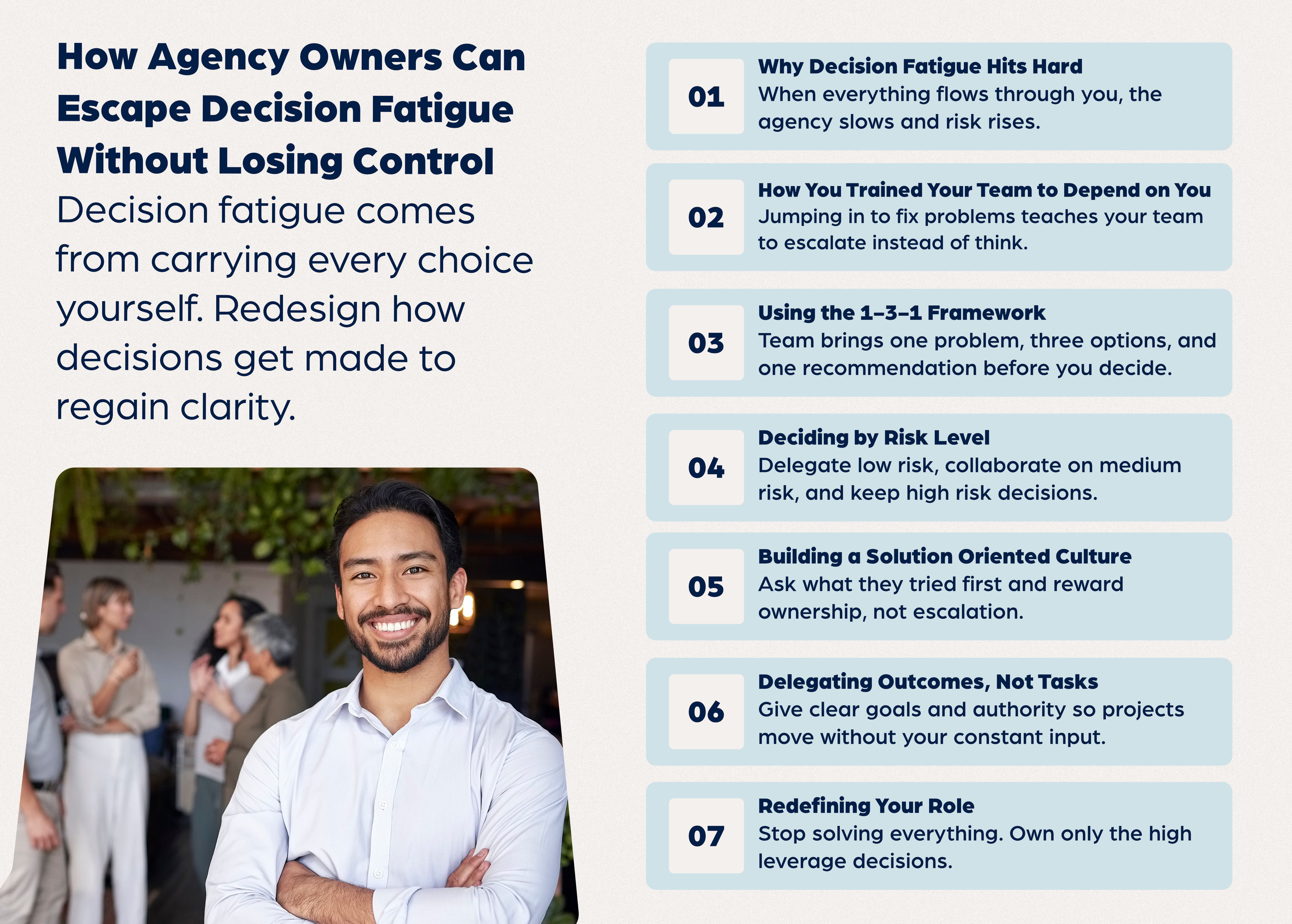
Why Decision Fatigue Hits Agency Owners So Hard
From the earliest days of your agency, one thing has always been true. The risk rests on your shoulders. If something goes wrong, you feel it in your bank account, your calendar, and your nervous system.
Because of that, you probably started out making every meaningful decision yourself. It was faster, and in the beginning, there often was no one else. That is reasonable in the first stage of the business.
If you keep operating that way as the agency grows, it becomes a liability.
Here is what happens when every decision routes through you:
- You become the bottleneck for approvals, scope changes, hiring, and escalations.
- Your team delays action, because they are waiting for your answer.
- You eventually start making rushed decisions with incomplete information.
- You train everyone to depend on you, which reinforces the cycle.
The uncomfortable truth is that your instinct to protect the business by holding every decision eventually puts the business at more risk. You cannot see everything, know everything, or think clearly about everything as the agency scales.
At some point, the work stops being about making more decisions and starts being about designing how decisions are made.
How You Trained Your Team To Send Everything To You
If your team brings you every problem and expects you to decide, it is rarely because they are incapable. It is because you unintentionally taught them that pattern.
It usually looks like this over time:
- Someone brings you a problem. You give an answer immediately.
- You jump in and fix issues instead of coaching people through them.
- You react strongly when something goes wrong, so people learn that it is safer to ask before acting.
- You reward people for flagging problems fast, not necessarily for taking ownership of solutions.
The message becomes very clear:
“If it matters, bring it to me. I will decide.”
The result is a team that escalates instead of one that solves. That might feel flattering for a while, until you realize you have trained everyone to hand you their mental load on top of your own.
Changing this does not mean you step away and hope for the best. It means you start to deliberately build decision making as a skill inside your team.
Use the 1-3-1 Framework To Retrain Decision Making
A simple way to start retraining your team is the 1-3-1 framework, originally popularized by Dan Sullivan. It forces better thinking without requiring you to write a playbook for every situation.
Here is how it works. Any time someone comes to you with a problem, they must bring:
One clear definition of the core problem
- Not a vague description.
- Not ten issues bundled together.
- One clearly articulated problem.
Three possible solutions
- They do not need to be perfect.
- They just need to be viable options they have thought through.
One recommendation
- The option they believe is best, and why
So instead of:
“The client is pushing back on timing, what should we do”
You get:
“The core issue is that the client is expecting delivery next Friday, and our team is realistically two weeks out.
Here are three options I see:
- Compress the internal schedule and ask the team to work late to keep the original date.
- Reset expectations with the client and negotiate a phased delivery.
- Remove one lower impact deliverable from this phase to keep the date.
My recommendation is option two, because it protects our quality and the team, while still giving the client movement next week.”
In the early days, your team’s solutions might miss things. Your job is not to grab the problem back and solve it. Your job is to ask questions that improve their thinking:
- “What is the risk of this option for our relationship”
- “How would this affect margin on the project”
- “What have you already tried with the client”
With repetition, a few things happen:
- Your team understands what you care about in decisions.
- Their recommendations improve.
- You spend less energy reaching a decision, even when you still make the final call.
You are training people to think like owners without giving up your authority.
Use Risk Levels To Decide Who Decides What
Even with better thinking around you, some decisions should stay with you. The key is to stop treating all decisions as if they carry the same weight. They do not.
You can break decisions into three basic risk levels:
Low risk decisions
- Small internal purchases.
- Minor process tweaks.
- Low impact client preferences.
- Reversible choices with limited downside.
These are perfect for full delegation. If someone understands the values and basic guidelines, they should be able to decide and move.
Medium risk decisions
- Scope changes that affect delivery.
- Modest pricing adjustments.
- Tool or vendor selection.
- Client facing decisions that have some impact on margin or timeline.
These are ideal for 1 3 1. Your team brings the problem, options, and recommendation. You approve, adjust, or redirect.
High risk decisions
- Major changes to pricing or packaging.
- Senior hires and leadership shifts.
- Large contracts and commitments.
- Strategic moves that affect positioning or service lines.
These should remain with you, even if your team feeds into them.
When you label decisions this way, you can make clear agreements:
- Which categories each role can own.
- Which require collaboration.
- Which stay at the owner or executive level.
The more clearly you define this map, the faster your agency moves and the less mental load sits on your shoulders.
Build a Solution Oriented Culture
Frameworks only work if the culture supports them. If people feel punished every time something is not perfect, they will not take ownership. They will send everything back to you to avoid being blamed.
To build a solution oriented culture, make a few conscious shifts.
Change the default question.
When someone asks, “What should we do” respond with:
- “What have you already tried”
- “What options have you considered”
- “What do you recommend and why”
You are training the reflex to think before escalating.
Reward ownership, not just outcomes.
You still hold a high bar for quality. At the same time:
- Acknowledge when someone steps up to solve a problem.
- Recognize thoughtful attempts, even if they are not perfect.
- Use missteps as learning moments rather than public takedowns.
The goal is not to celebrate mistakes. It is to celebrate responsible ownership and improvement over time.
Reframe problems as system gaps.
Instead of seeing every issue as “this person failed,” ask:
- “Where did the process break down”
- “What resource was missing”
- “Which decision guidelines were unclear”
This keeps you and your team focused on building a better machine rather than personalizing every problem.
Start Delegating Outcomes, Not Just Tasks
Task level delegation sounds like:
- “Send this email draft”
- “Move this meeting”
- “Research these three tools and send me a list”
There is a place for that, especially with junior team members. But as your leadership bench grows, you need to shift toward outcome level delegation.
Outcome delegation sounds more like:
“Our project management system is not working for where we are now.” Your outcome is a new setup that:
- Gives us visibility on capacity
- Works across departments
- Integrates with our existing tools
- Is fully rolled out and adopted within 90 days.
I want you to own the research, selection, rollout plan, and implementation. Bring me a recommendation for final approval before we commit.”
You can think about levels of delegation like this:
- Research and report back
- Research, analyze, recommend, and I decide
- Research, decide, and I approve before implementation
- Research, decide, implement, and inform me afterward
Not every person or situation warrants level four. The point is to be explicit about the level you are using, instead of defaulting to doing the thinking yourself.
As you move more decisions up this ladder, you will notice that big projects start happening without you needing to carry every micro decision involved.
Redefine Your Role As Owner
The long term goal is not to become irrelevant. It is to focus your energy on the decisions that are truly owner level.
That means shifting your role from:
- “Person who solves every problem”
to:
- “Person who designs how problems are solved”
- “Person who decides the few key yes or no moments that really shape the business”
Practically, that looks like:
- You define the direction and priorities.
- You set decision boundaries and risk thresholds.
- You insist on 1 3 1 thinking from your team.
- You keep high risk, high leverage decisions on your plate.
- You vacate space in other areas so your leaders can step in
There is a mindset shift here as well. For many owners, identity and self worth have been tied to being the one everyone relies on. Letting go of that can feel uncomfortable. At the same time, it is often the gateway to the next level of growth, both for you and for the agency.
You cannot have a team of owners if you never stop standing in the only space where ownership is allowed.
Putting These Frameworks To Work Inside Your Agency
You do not need to redesign your entire decision system this week. Start small and consistent. Here is a practical way to begin over the next 30 days:
Tell your leadership team that from now on, when they bring you problems, you expect 1 3 1:
- One clear problem.
- Three options.
- One recommendation.
Make a quick list of common decisions you are currently making and categorize them as low, medium, or high risk.
- Immediately delegate a handful of low risk decisions to trusted team members.
- Require 1 3 1 for medium risk decisions.
- Keep high risk decisions, but ask for input so your team learns how you think.
In your next few one to ones, ask each direct report:
- “Where do you feel blocked waiting on my decisions”
- “Which decisions do you feel ready to own with more clarity”
Choose one project in the next month to delegate as an outcome, not a task, along with clear success criteria and level of authority.
Pay attention to your own reactions when something goes wrong.
- Take a beat before you respond.
- Ask what the person learned.
- Look at what process or clarity was missing.
With each small change, you reduce the number of decisions that land on your desk, without stepping away from your responsibilities as a leader. Your team becomes more capable. Your days become less reactive. The business becomes less fragile.
Decision making will always be part of your job. It just does not need to be every part of your job. When you design your agency so that more people can think, decide, and own within clear boundaries, you create space for yourself to lead the business instead of constantly holding it together.