


There are a lot of good agencies out there. You know that. Your prospects know that.
And that is exactly why doing great work is not enough to consistently win the right clients.
If you want to stop hearing things like
“Your proposal looks great, but we went with the cheaper option”
you have to change the game you are playing.
Price is usually the last thing that gets discussed in a sales process, but it is almost always the first thing agency owners blame when they lose a deal. In reality, by the time you are being compared by price, you have already lost the positioning battle.
This is not a pricing problem. It is a positioning problem.
In this article, we will walk through how to position your agency as the obvious choice before price even comes up, why consultation is more valuable than a quote, and how to help clients think in terms of risk and outcomes instead of logos, websites and hourly rates.
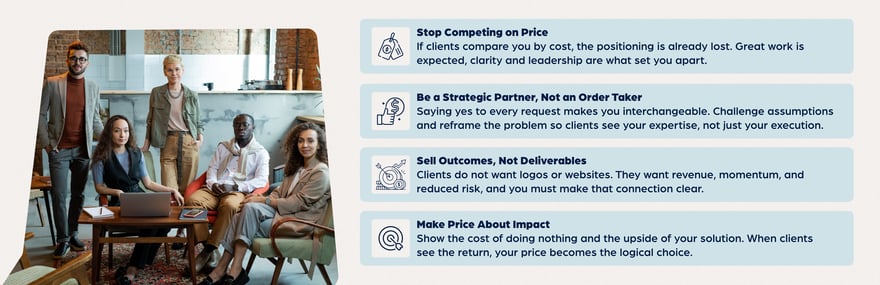
Relationship seller vs challenger: why “being nice” is not enough
There is a sales book called The Challenger Sale. It is not exactly a page turner, but the core idea is powerful.
Researchers studied thousands of sales reps during the Great Recession. Conventional wisdom said the best salespeople were the “relationship builders” – the ones who were friendly, likable and made prospects feel good.
The data showed something different. The top performers were the ones who:
- Came into the conversation with a clear point of view
- Challenged the client’s assumptions
- Brought insight and context the client did not have
They did not win by being rude. They won by being confident, consultative and willing to say, “I hear what you are asking for, but that might not be what you actually need.”
That is the shift most agencies need to make.
Too many agencies default to agreement.
- The client says, “We need a new website.” You say, “Great, we build websites.”
- They say, “We want TikTok content.” You say, “Amazing, we do that too.”
You mirror their language, echo their diagnosis and then send a proposal. At that point, what is the real difference between you and a cheaper freelancer, a junior designer or a cousin who “just took a web design class”?
If your only value is that you can technically produce the thing they already asked for, you have boxed yourself into a price comparison.
Order taker vs strategic partner
Let’s be blunt.
If all you do is say yes and take orders, you should be the cheapest option. You are not actually reducing risk. You are not helping them make a smarter decision. You are not using the 10, 20 or 30 years of experience you have earned.
A strategic agency does something very different. It reframes the entire conversation.
An order taker responds to:
“Can you redesign our website?”
A strategic partner responds to:
“Why now? What is not working today? What happens if nothing changes? What is success financially in the next 12 months?”
Same initial request. Completely different conversation.
One puts you in the commodity box.
The other puts you in the “I cannot afford to do this without them” box.
Clients are not buying the thing, they are buying the outcome
Most agencies secretly know this, but they do not consistently sell this way.
Clients do not actually care about:
- A brand guide
- A new logo
- A shiny website
- A set of ads
They care about:
- More sales
- More qualified leads
- Shorter sales cycles
- Confidence in a big launch
- A promotion or recognition internally
The deliverable is just the vehicle.
When you sell the vehicle instead of the destination, you train the client to think in terms of features, formats and hours, not business impact. That is how you end up in a conversation where a prospect feels comfortable saying:
“We love your work, but my niece can also build a site. She just took a web design course. We will go with her.”
It is frustrating, but it is also honest feedback. You did not show a meaningful difference between your expertise and a beginner with software access. From the client’s vantage point, they were choosing between “website” and “website”. Of course price wins in that scenario.
Signs you are accidentally competing on price
If any of these feel familiar, you are in a price war, whether you like it or not:
- Prospects ask for a “quote” before you have talked about goals, numbers or context
- You lose deals to clearly less experienced providers and your first reaction is “I must be too expensive”
- Your proposals are heavy on deliverables and light on outcomes, metrics and risk reduction
- You hear a lot of “we need to think about it” after presenting price
These are not solved by discounting. They are solved by repositioning.
Your point of view is the product
If you have been in the game for any meaningful amount of time, you have experience your clients do not.
You have:
- Seen launches work and flop
- Watched trends rise and die
- Tested strategies that sounded good in theory and failed in reality
- Guided clients through messy, imperfect situations and still created wins
That experience is not a nice-to-have. That is the value.
When a prospect walks into a sales call, they are usually showing up with:
- A surface level understanding from books, podcasts or social media
- A half-formed hypothesis about what they need
- A bunch of pressure, risk and uncertainty sitting on their shoulders
Your job is not to agree with their hypothesis. Your job is to pressure test it.
That can sound like:
- “I understand why you are thinking about social media first. Can I share what we have seen happen with businesses at your stage when they start there?”
- “You said you want a rebrand because things feel stale. When you say ‘stale’, are you seeing that show up in sales, lead quality or something else?”
- “Before we talk about creative, can we look at the numbers for a moment so we know what actually needs to change?”
You are not telling them they are wrong. You are showing them that they are not alone, and that your experience has already walked this path before.
Price is a story about risk and return
When a client hears a price, they are not only thinking, “Is this number big or small?”
They are thinking:
- “How risky is it to trust this agency?”
- “How likely is it that this actually works?”
- “What is the cost of this failing?”
- “What happens if we do nothing?”
Your job in the sales process is to shape that risk and return story.
Instead of:
“This will cost 80,000.”
Shift to:
“Right now, your site is converting at 1 percent. Based on your average order value and monthly traffic, that is costing you roughly 600,000 per year in lost revenue.
Our goal with this redesign is not a prettier site. It is to move your conversion rate to at least 1.5 percent in the first year. Even at that conservative number, you would see an additional 300,000 per year in revenue, which is almost four times the investment.
Our averages with similar clients are closer to 3 percent, but I like to plan against the conservative scenario first.”
Then you show the price.
They are no longer buying a website. They are buying a clear, structured path toward measurable impact.
When you raise prices and almost nothing changes
One of the most consistent patterns seen across agencies is this:
- They are undercharging
- They are closing work
- They are exhausted and stretched
- They are afraid to raise prices
Then they raise their price substantially. And something surprising happens.
Close rates dip only slightly. Revenue per project increases dramatically. Capacity eases. Results improve because expectations and boundaries change.
Most agencies discover for the first time that price was never the issue. Positioning was.
Show, do not just tell
Strong positioning is not built on the fanciest deck. It is built on your ability to show the thinking behind your work.
For example, instead of walking through a portfolio like:
“Here is a site we did. Here are some screens.”
Explain the story behind it:
“When this client came to us, they were converting at 1 percent. Their messaging was speaking to the wrong market. We restructured the positioning, updated the hierarchy, and redesigned the layout to match how buyers actually make decisions. They saw demo requests increase by 140 percent.”
You are no longer presenting design. You are presenting evidence.
Practical ways to shift your positioning starting today
You do not need a new brand, a new deck or a new service offering. You can shift immediately by adjusting how you show up in conversations.
Here are a few ways to do that:
- Prepare insights that relate directly to their goals and stage
- Spend more time diagnosing than pitching
- Challenge gently when their assumptions will lead them to poor decisions
- Connect recommendations to outcomes, not outputs
- Present pricing only after you have built a business case
These subtle shifts reshape how clients see you. You stop being one option among many and start feeling like the only agency that truly understands the stakes.
Position yourself as the partner they cannot afford to lose
The best agencies are not chosen because of design portfolios, pitch decks or price tags. They are chosen because they lead with clarity and conviction, and because they make clients feel safer and more confident about the path ahead.
When you position your agency around insight, expertise and outcomes, saying no to you becomes riskier than saying yes.
That is how you become the obvious choice.