


Most creative agencies do not fall apart because of their creative ability. In fact, many agencies are excellent at what they do. They land strong clients, deliver compelling work, and build impressive portfolios.
What actually breaks agencies is growth without structure.
As more projects come in, timelines tighten. Communication becomes scattered. Quality becomes inconsistent. The founder gets pulled back into the day-to-day, making decisions they thought they had already delegated.
This is not a talent problem. It is a delivery problem.
The agencies that grow year after year are not lucky. They build infrastructure that allows them to grow without chaos, burnout, or the founder acting as the glue holding everything together.
This article breaks down how high-performing creative agencies structure their delivery pipeline so they can grow predictably, protect margins, and maintain creative quality.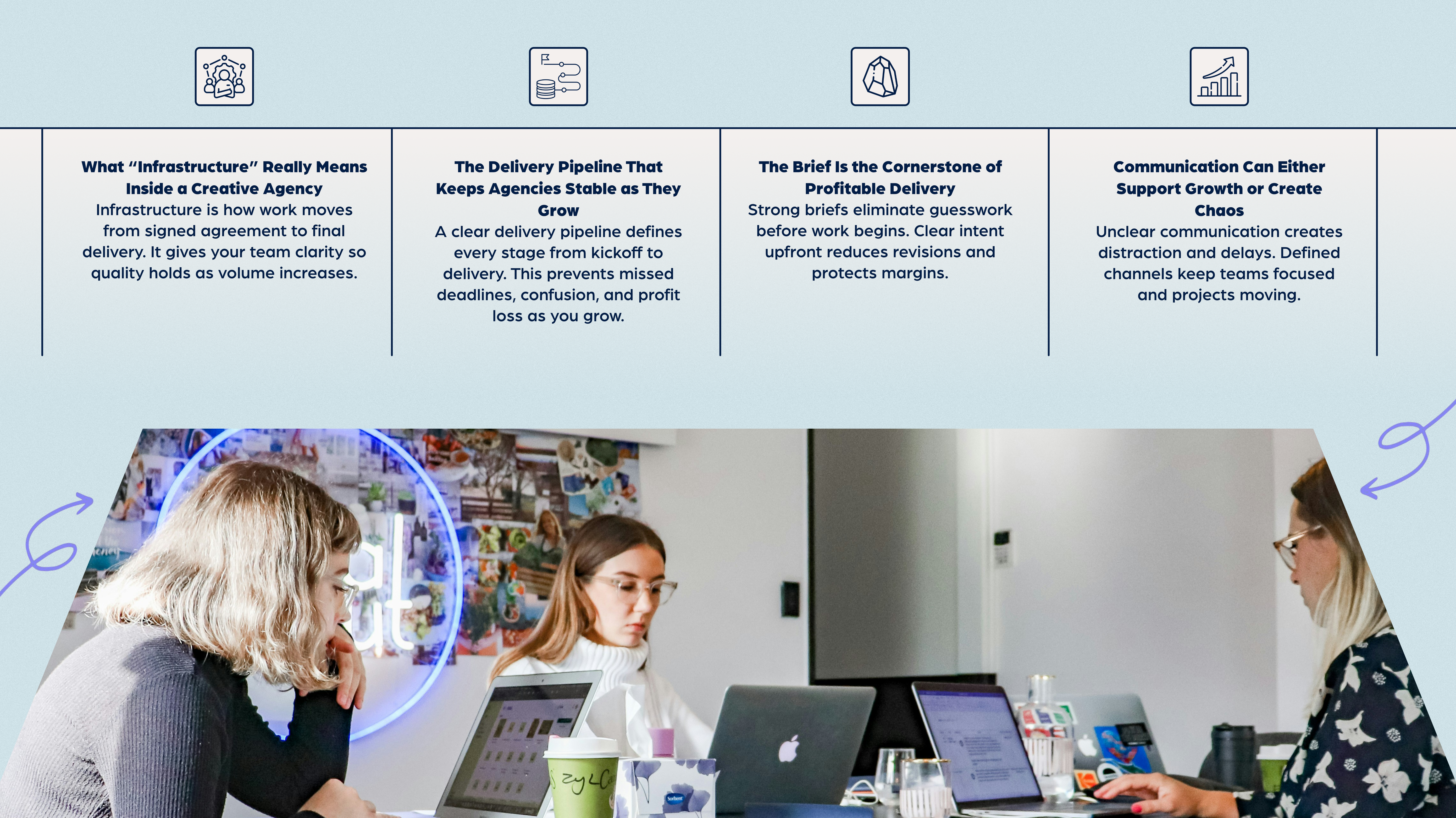
What “Infrastructure” Really Means Inside a Creative Agency
Infrastructure is not red tape or corporate bureaucracy. It is the collection of systems that guide work from a signed agreement to final delivery.
Inside a creative agency, infrastructure includes:
- How projects are launched internally and with clients
- How briefs are created and shared
- How information flows between team members
- How decisions get made
- How feedback is collected and applied
- How timelines are protected
These are not big systems on their own. They are small processes that work together. One ends, another begins. When designed intentionally, they create a seamless experience for both clients and your team.
Infrastructure matters more than talent alone. You can hire world-class designers and strategists, but without the right information and direction, they will still produce the wrong outcome.
Great infrastructure gives great talent clarity.
The Delivery Pipeline That Keeps Agencies Stable as They Grow
Every sustainable agency follows a clear delivery pipeline. Whether you sell projects or retainers, the structure is the same. Only the rhythm changes.
A strong delivery pipeline typically includes:
- Signed statement of work
- Internal project launch
- Client kickoff
- Project and creative briefing
- Big idea or initial production
- Design and execution reviews
- Client revisions
- Final delivery
For retainers, this pipeline repeats on a monthly or quarterly cycle. For projects, it runs from start to finish.
What matters is not just having these stages, but clearly defining what happens at each step. Each phase should have:
- A clear outcome
- An owner
- Supporting templates or SOPs
- Defined inputs and outputs
Without this clarity, projects drift. Timelines slip. Revisions pile up. Profitability quietly erodes.
Why Project Launch Is Where Most Agencies Lose Control
Many delivery issues show up late, but they start early.
Poor project launches create confusion that surfaces weeks later as missed deadlines, excessive revisions, and frustrated clients. High-performing agencies treat project launch as a non-negotiable system, not a casual meeting.
Before a client ever joins a kickoff call, the internal team should already be aligned on:
- Scope and success criteria
- Timeline and milestones
- Roles and responsibilities
- Known risks and constraints
This requires a standardized internal kickoff agenda and template. Everyone knows what information is required and where it lives.
Client kickoff follows the same principle. Clients should leave that meeting knowing:
- What happens next
- What decisions they are responsible for
- How feedback will be given
- When communication happens
When expectations are set early, projects move faster and feel calmer for everyone involved.
The Brief Is the Cornerstone of Profitable Delivery
If there is one system that separates high-performing agencies from struggling ones, it is the briefing process.
Weak briefs create endless revisions. Endless revisions destroy margins.
Across agencies we have worked with, 80 to 90 percent of revisions can be traced back to unclear or incomplete briefs at the start of a project.
Strong briefs create alignment before work begins.
A solid brief removes guesswork by clearly outlining:
- The ideal customer profile
- Context for where the work will live
- Business goals and success metrics
- Challenges and constraints
- Strategic intent behind the work
- The Big Idea
High-performing agencies do not rely on memory or scattered notes. They use templates.
Most benefit from having:
- An account brief that evolves over time
- A project or creative brief tied to specific deliverables
Templates ensure consistency without killing creativity. They protect your team from starting in the wrong direction and protect your margins from unnecessary rework.
Role Clarity Keeps Projects on Track
Many agency bottlenecks are not caused by workload. They are caused by confusion.
When multiple people assume someone else owns a task, nothing moves. When accountability is unclear, timelines quietly slip.
This is where RACI becomes essential.
RACI defines who is:
- Responsible (R): The person doing the work. They own completing the task and moving it forward.
- Accountable (A): The owner of the outcome. They approve the final result and are ultimately on the hook if it’s wrong or late.
- Consulted (C): The subject-matter inputs. They’re brought in before decisions are made to give guidance, context, or expertise.
- Informed (I): The people kept in the loop. They get updates after decisions are made, but they don’t need to weigh in.
Every major phase of a project should have these roles clearly defined.
For example, on a brand project:
- The creative director may be responsible and accountable for the brief
- The strategist and account manager are consulted
- Designers and copywriters are informed
This clarity prevents silent delays and internal friction.
It also protects profitability. Every week a project runs past its planned timeline can erode more than six percent of net profit. On tight margins, that adds up fast.
Project Management Is Your Single Source of Truth
Project management is not glamorous, but it is foundational.
It does not matter which tool you use. What matters is that it becomes the center of truth for your agency’s delivery.
Your project management system should:
- Mirror your delivery pipeline
- Assign clear ownership to every task
- Link SOPs and templates where needed
- Track review and quality control stages
Files should live in a structured drive. Feedback should be centralized. Nothing critical should live only in chat messages or someone’s head.
High-performing agencies treat project management as infrastructure, not admin work.
Communication Can Either Support Growth or Create Chaos
Communication is the hidden source of most agency problems.
Too little communication creates confusion. Too much communication creates noise.
Many agencies fall into the trap of using tools like Slack as everything at once. Project management, decision-making, updates, and casual conversation all blur together. The result is constant distraction and unclear priorities.
Sustainable agencies define communication rules.
They decide:
- Which channel is used for what
- When responses are expected
- What requires immediate attention versus later review
Even small conventions help. Simple prefixes like “FYI” or “reply when ready” reduce unnecessary urgency and mental load.
Communication should support execution, not interrupt it.
How High-Performing Agencies Handle Quality Control
Creative quality does not come from hovering over your team. It comes from structured review.
A practical rule of thumb is to invest most review time early in the project, when direction is being set.
Many agencies find success by allocating:
- Around 60 percent of review effort at the beginning
- 20 to 25 percent in the middle
- The remainder toward final polish
Early reviews shape the trajectory. End of project reviews refine execution.
Some high-performing agencies also introduce peer reviews at key stages. Bringing in another designer at 30 and 60 percent completion provides fresh perspective, reinforces standards, and spreads learning across the team.
Quality control is not about micromanagement. It is about clarity, standards, and consistency.
Templates Create Capacity Without Sacrificing Creativity
One of the fastest ways to reclaim time is by templating what does not need to be reinvented.
This does not mean templating creative output unless that fits your model. It means templating everything around the work.
Examples include:
- Brief templates
- Kickoff agendas
- Internal review structures
- File and folder organization
- Client follow-up sequences
Every minute a designer spends recreating structure is a minute taken away from creative thinking. That is a poor use of talent.
Templates free your team to focus on the work they do best.
Why Client Feedback Needs a System
Client delays are one of the biggest threats to agency profitability.
High-performing agencies do not hope for timely feedback. They design systems that make it likely.
That includes:
- Setting feedback expectations upfront
- Sending reminders before deadlines
- Pre-booking review meetings
- Clearly defining when feedback windows close
When feedback is late, timelines slip. When timelines slip, margins shrink.
A structured feedback system protects both the client experience and your bottom line.
How to Implement a Delivery System That Creates Sustainable Growth
Infrastructure is not about control. It is about freedom.
When your delivery system is clear and consistent:
- Projects move without constant founder involvement
- Teams execute without guessing
- Quality remains high as volume increases
- Growth feels predictable instead of fragile
The founder no longer acts as the bottleneck. The system moves things forward.
If you want to grow without burnout, start by auditing your delivery pipeline. Identify where confusion shows up, where revisions pile up, and where timelines break down. Those pressure points reveal where infrastructure is missing.
Build the system once. Refine it over time. Let it carry the weight of growth.