


Most agency owners pour enormous amounts of time and energy into winning clients.
They refine their pitch, perfect their proposals, build onboarding systems, and work tirelessly to deliver exceptional results. Then the project ends and everything simply stops.
The final invoice gets sent. Maybe there is a short email exchange. Files are transferred. Passwords are shared. Everyone moves on.
For many agencies, that is the entire offboarding process.
The problem is that this approach leaves one of the most valuable opportunities for agency growth completely untapped.
What many agency owners fail to realize is that clients often remember how a relationship ends more vividly than how it began. The final interaction becomes the lasting impression. In a service-based business, that lasting impression can determine whether a client refers new business, provides a powerful testimonial, returns for future work, or forgets about your agency altogether.
If your goal is to build a more predictable and sustainable agency, client offboarding should not be viewed as an administrative task. It should be treated as a strategic business system.
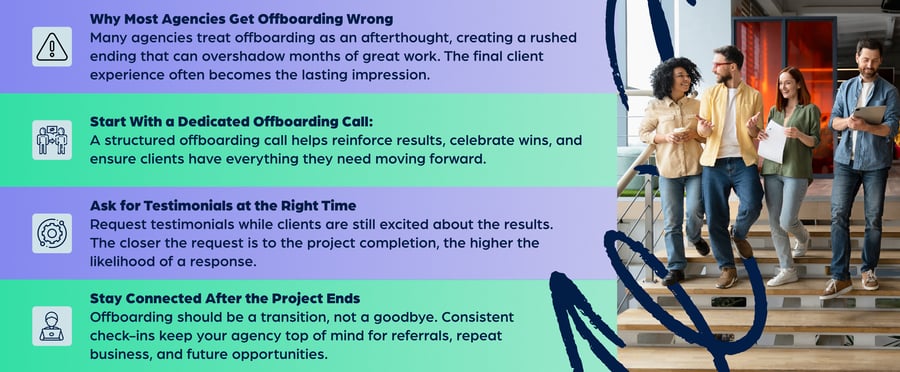
Why Most Agencies Get Offboarding Wrong
The reason offboarding is often neglected is simple.
Most agency owners view the end of a project as a finish line. They are eager to move on to the next client engagement, the next project deadline, or the next sales opportunity.
As a result, the closing phase becomes rushed and reactive rather than intentional and strategic.
This creates several problems.
Important information gets overlooked. Clients may feel unsupported after the project ends. Questions remain unanswered. Assets become difficult to locate. Passwords and documentation get lost.
Even worse, these small frustrations can overshadow months of excellent work.
A client may have been thrilled with the results you delivered, but if the final experience feels disorganized or incomplete, that becomes the memory they carry forward.
The agencies that consistently generate referrals and repeat business understand something important. The project may be ending, but the relationship should not.
The Business Impact of a Strong Offboarding Process
A structured offboarding process creates opportunities that many agencies spend thousands of dollars trying to generate through marketing and sales.
When clients leave feeling supported, appreciated, and confident about their next steps, they become advocates for your agency.
A strong offboarding experience can help you:
- Generate more referrals from satisfied clients
- Collect stronger testimonials while results are still fresh
- Create opportunities for future engagements
- Strengthen your reputation and professionalism
- Stay top of mind when new opportunities arise
- What type of testimonial you are requesting
- How the testimonial will be used
- What information would be most helpful
- How much time it will take
- Final deliverables and project assets
- Strategic documentation and recommendations
- Training videos or Loom recordings
- Login credentials and account access information
- Contact information for future support
The reality is that referrals rarely come from clients who were simply satisfied. They come from clients who had a memorable experience from beginning to end.
That final experience is often the deciding factor.
Start With a Dedicated Offboarding Call
One of the most effective ways to create a memorable client experience is to schedule a formal offboarding or project sunset call.
Many agencies skip this step entirely, which is a missed opportunity.
An offboarding call creates space to acknowledge the work that was completed and reinforce the value that was delivered. It allows both parties to reflect on the outcomes achieved while ensuring the client has everything they need moving forward.
During this conversation, review the project goals, celebrate milestones, discuss results, and confirm that all deliverables have been transferred successfully.
Most importantly, make sure the client understands the impact your work had on their business.
Many agency owners move so quickly into delivery mode that they never pause to help clients connect the work completed with the results achieved. This conversation gives you the opportunity to reinforce that value.
At Creative Agency Success, we often encourage agency owners to think of this call as a strategic discussion rather than a sales conversation.
A useful framework is the 70/30 rule.
Spend roughly 70 percent of the conversation discussing future opportunities that align with services your agency offers and 30 percent discussing ideas or strategies outside your scope.
This demonstrates that your recommendations are genuinely focused on helping the client achieve their goals rather than simply generating additional revenue.
*Note: If your work takes time to have business impact, have the asset transfer call and pre-schedule an impact review call, then follow the same rules above.
Ask for Testimonials at the Right Time
One of the biggest mistakes agencies make is waiting weeks or months to request a testimonial.
By that point, the excitement has faded. The project details are no longer fresh. The client is focused on other priorities.
The best time to request a testimonial is during the offboarding process itself, while the client is still experiencing the positive outcomes of the engagement.
Make the process simple and transparent.
Let the client know:
If you prefer video testimonials, schedule the recording immediately. If you want written feedback, provide clear prompts that make responding easy.
The easier you make the process, the more likely clients are to participate.
Remember, people are often happy to share positive feedback when they feel appreciated and when the request feels straightforward.
Create a Professional Offboarding Kit
Another powerful way to elevate your client experience is by creating a formal offboarding package.
This serves as the final deliverable that ties everything together and ensures clients have easy access to the resources they need.
Your offboarding kit might include:
A centralized client portal can make this process even more effective.
When clients need to revisit project materials in the future, they are reminded of your agency and the value you provided. This creates an ongoing touchpoint long after the project has ended.
More importantly, it removes frustration and creates confidence.
Clients should never wonder where to find an important file or who to contact if they need assistance.
Stay Connected After the Project Ends
The most successful agencies understand that offboarding is not the end of a relationship.
It is simply a transition into a different stage.
Many agency owners disappear completely once a project is complete. Months later, they attempt to reconnect when they need new business.
Unfortunately, relationships do not work that way.
Instead, make a habit of checking in periodically.
These touchpoints should not feel like sales outreach. They should feel helpful, relevant, and relationship-focused.
Share an article that relates to their industry. Send a quick message asking how things are progressing. Reach out when you see an opportunity that may help them achieve their goals.
These small interactions build trust over time and keep your agency top of mind.
This becomes especially valuable when contacts move between organizations. A client who changes companies may become an advocate for your agency in an entirely new business.
Those opportunities rarely happen when relationships are allowed to go cold.
Turning Finished Projects Into Future Opportunities
Most agency owners focus heavily on client acquisition because it feels like the primary driver of growth.
While winning new business is important, sustainable growth often comes from maximizing the relationships you have already worked so hard to build.
A structured offboarding process helps protect the investment you made in acquiring and serving each client. It transforms completed projects into future opportunities by creating stronger relationships, generating referrals, encouraging repeat business, and producing testimonials that support future sales efforts.
If your current offboarding process consists of sending a final invoice and moving on, this is one of the highest-leverage improvements you can make in your agency.
Start by implementing a dedicated offboarding call, creating a professional offboarding kit, requesting testimonials at the right time, and building a simple system for ongoing client follow-up.
The agencies that grow most consistently are not always the ones winning the most new clients. They are often the ones that make the most of every relationship they already have.
When done correctly, client offboarding is not about saying goodbye.
It is about creating the foundation for what comes next.