


Every creative agency owner knows this moment.
Your team has done the work. The strategy is sound, the design is thoughtful, and you feel confident sending it to the client. Then the reply comes back:
“I’m not sure.”
“It doesn’t really feel right.”
“Can we try something different?”
Suddenly, you are on revision four, the deadline is long gone, the team is frustrated, and nobody can clearly explain what went wrong.
Here’s the uncomfortable truth: the problem usually is not the work. The problem is the way the feedback was requested.
For too many agencies, client reviews start with one expensive question: “What do you think?”
It sounds harmless. It feels collaborative. But in reality, it opens the door to vague opinions, subjective preferences, and feedback that sends the project in circles. Most clients are not trained to give creative direction, so when you ask an open-ended question, you accidentally put them in a role they were never equipped to fill.
That does not mean clients should be ignored. It means they need to be guided.
If you want cleaner approvals, stronger client relationships, and healthier margins, you need a structured feedback process that keeps the agency in the leadership seat while still making the client feel heard.
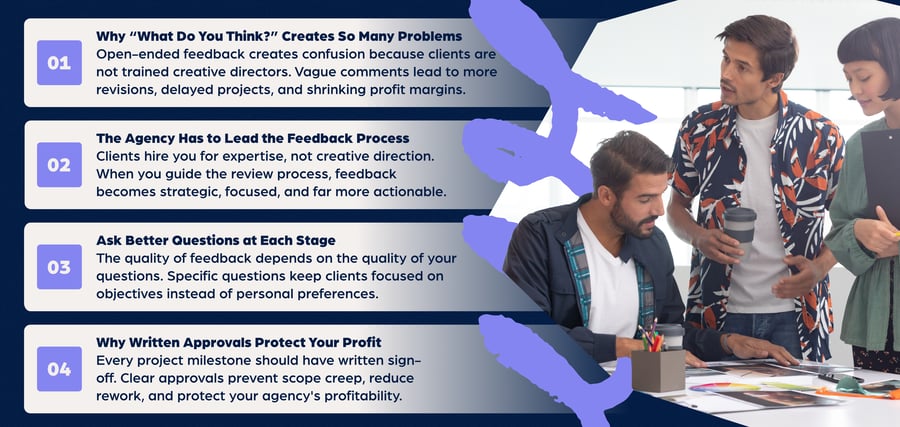
Why “What Do You Think?” Creates So Many Problems
Clients hire your agency because they need expertise. They may understand their business, their audience, and their goals, but they usually do not know how to evaluate creative work through a strategic lens.
When you ask, “What do you think?” you are not asking for useful input. You are asking for personal reaction.
That is where feedback starts to get messy.
A client might say they do not like a color, but what they really mean is that the design feels too bold for their audience. They might ask to “make it pop,” but what they really mean is that the hierarchy is not helping them understand the message quickly enough. They might disappear for three weeks because they feel unsure, but they do not know how to explain what is making them uncomfortable.
Without structure, the client gets anxious, the agency gets frustrated, and the work starts moving away from the strategy that was approved in the first place.
That confusion has a real cost. Every extra revision eats into profit margin, delays the next phase of the project, and pulls your team back into work they thought was already complete. It also chips away at morale, because creative people do not thrive when they are repeatedly asked to rework something without a clear reason.
And when the client sees constant rounds of changes, their confidence in the agency can start to erode, even if the original work was strong.
The “I’ll Know It When I See It” Client Is Usually a Brief Problem
Every agency eventually runs into the client who says, “I’ll know it when I see it.”
That statement can be frustrating, but it is usually not a feedback problem. It is a brief problem.
When a client cannot clearly evaluate the work, it often means the goals, criteria, or creative direction were not defined tightly enough at the beginning. The client may feel uncomfortable, but they do not have the language to explain why.
That is why the brief matters so much.
Before the work begins, the agency and client need to agree on what success looks like. What is the goal? Who is the audience? What does the work need to communicate? What should the audience feel or do next? What constraints matter?
When those answers are unclear, feedback becomes a guessing game.
A strong brief gives both sides a shared reference point. It protects the team from endless revisions and gives the client more confidence when reviewing work. If a client starts drifting into vague feedback, you can bring the conversation back to the agreed strategy instead of debating opinions.
The Agency Has to Lead the Feedback Process
A better review process starts with a mindset shift: you are the expert, not the client.
That does not mean you become controlling or dismissive. It means you take responsibility for the process you were hired to lead.
The best client relationships are not driven by the client’s scattered opinions. They are guided by the agency’s expertise, strategy, and ability to translate client input into better business outcomes.
When you lead the feedback process, you help the client understand what they are reviewing, why it matters, and what kind of input is useful at that stage. That turns feedback from a subjective debate into a focused business conversation.
Instead of asking broad questions that invite personal taste, you ask specific questions that connect back to the project objective.
For example, if you are reviewing a website wireframe, you should not ask, “Do you like it?” At that stage, visual polish is not the point. A better question would be:
“Is there any information missing from this page that a buyer would need before feeling confident enough to take the next step?”
That kind of question gives the client a clear lane. It also protects the work from feedback that belongs in a later stage.
How to Present Creative Work With Context
One of the biggest mistakes agencies make is presenting work without enough framing. If you send a design, strategy, or concept without context, the client is left to interpret it on their own.
That is when they default to personal preference.
Before showing the work, remind the client what they are looking at and why it exists. This does not need to be a long presentation, but it does need to create the right lens.
A strong review should remind the client of:
- Where you are in the project and what stage is being reviewed
- The original goal, audience, and business objective
- The research, insights, and client input that shaped the work
- The specific type of feedback you need from them right now
- “Does this direction reflect the positioning we agreed on during strategy?”
- “Is there anything here that would confuse your target audience?”
- “Based on the objective, does this give the buyer enough clarity to take action?”
- “Is anything missing that would prevent this from being approved at this stage?”
- A clear project brief before work begins
- A structured presentation format for every review
- Specific questions based on the project stage
- Written approval at each major milestone
- Clear scope boundaries for changes after approval
This simple framing changes the conversation. Instead of reacting with “I like it” or “I don’t like it,” the client can evaluate whether the work is doing the job it was designed to do.
It also shows that your team did not arrive at the recommendation randomly. You considered options, made intentional decisions, and selected the direction that best supports the client’s goals.
That is important because many clients do not understand how much thinking happens before they ever see the final work. When you walk them through the reasoning, they gain confidence in the process and are less likely to second-guess every detail.
Ask Better Questions at Each Stage
The quality of your feedback depends on the quality of your questions.
If your questions are vague, the feedback will be vague. If your questions are strategic, the feedback becomes much more useful.
At each stage, narrow the client’s attention to the decision that actually needs to be made.
For wireframes, ask whether the right information is included and whether the flow supports the user’s decision-making process.
For early visual concepts, ask whether the direction reflects the intended brand attributes and emotional tone.
For final creative, ask whether anything is factually incorrect, misaligned with the approved strategy, or likely to create confusion for the target audience.
This keeps feedback focused on effectiveness rather than taste.
Here are a few examples of better review questions:
These questions still give the client a voice, but they do not hand over creative control. They invite the client to respond within the frame of the strategy.
That is the balance every agency needs.
Why Written Approvals Protect Your Profit
Structured feedback is not just about better conversations. It also needs to include formal approval points.
Verbal approvals are not enough.
If a client approves a concept on a call, then changes their mind three weeks later, your team has very little protection unless that approval was documented. That is how agencies end up reworking entire phases for free.
Every major milestone should have written sign-off. This could include concept approval, wireframe approval, design direction approval, final creative approval, or any other key project stage.
Written approvals help make expectations clear. They also give you a professional way to handle changes that fall outside the approved direction.
This does not have to feel harsh. It can be framed simply:
“Once this stage is approved, any changes to the approved direction will be handled as a new scope adjustment.”
That kind of clarity protects the relationship because it removes confusion before it becomes conflict.
What Changes When You Own the Process
When you stop asking “What do you think?” and start leading a structured review process, the entire project feels different.
Clients become calmer because they understand what they are reviewing. Your team becomes more confident because the feedback is clearer. Projects move faster because decisions are tied to strategy instead of opinion. Margins improve because fewer hours are lost to unnecessary revisions.
Most importantly, client trust increases.
A structured process shows the client that your agency is not just there to make things look good. You are there to guide them toward better decisions, stronger outcomes, and a smoother path from idea to execution.
That is what clients actually want.
They do not want to be creative directors. They want to feel confident that they hired the right team.
How to Implement a Better Feedback System
Start by looking at your current review process and identifying where feedback tends to break down. If revisions usually spiral during design, tighten the way you present concepts. If approvals get fuzzy between phases, add written sign-offs. If clients give vague feedback, replace broad questions with specific ones.
A strong feedback system should include:
You do not need to overhaul your entire agency overnight. Start with your next client review. Before you present the work, frame the objective, explain the thinking, and ask targeted questions that keep the conversation focused.
That one change can reduce revision cycles, protect your team’s energy, and help your clients feel more confident in the work they are approving.
Because better feedback does not happen by accident. It happens when the agency leads.