


Most agency owners never expected burnout to become part of their journey. In the early days, you felt energized by the work, the clients and the opportunity to create real impact. You built the agency with excitement, believing you would have more control, more freedom and more room for your creativity.
But as time passed, the excitement began to fade. The days felt heavier. Tasks that once felt fulfilling became draining. The business that once inspired you started to feel like something you needed to escape.
Many owners assume burnout comes from long hours or too many responsibilities. In reality, burnout is rarely about the amount of time you work. Burnout happens when most of your time is spent on work that drains your energy instead of work that fuels it. When you understand burnout through this lens, you can redesign your role so your agency supports you instead of exhausting you.
Why Burnout Sneaks Up on Agency Owners
Burnout is not just about feeling tired. It is what happens when your energy has been quietly depleted for too long.
It often shows up as:
- Waking up exhausted even after sleep.
- Feeling resistance toward simple tasks.
- Being busy all day but never feeling accomplished.
- Feeling disconnected from work you used to love
Here is what surprises many agency owners:
- You can feel energized after a long day spent in your strengths.
- You can feel completely drained after a short day spent on misaligned tasks.
Burnout is not a matter of endurance. It is a matter of alignment.
Why Energy Matters More Than Time
Every day you have two limits: time and energy.
Time is fixed. You cannot add more hours to the day.
Energy is variable. It is influenced by the type of work you do.
- Strategic, creative and problem solving work often increases your energy.
- Administrative, operational or constant firefighting work often drains it quickly.
If most of your time is spent on energy draining responsibilities, burnout becomes almost unavoidable, even if you are technically working fewer hours.
This is why time management alone does not fix burnout. You have to understand how each type of work affects your energy and design your role accordingly.
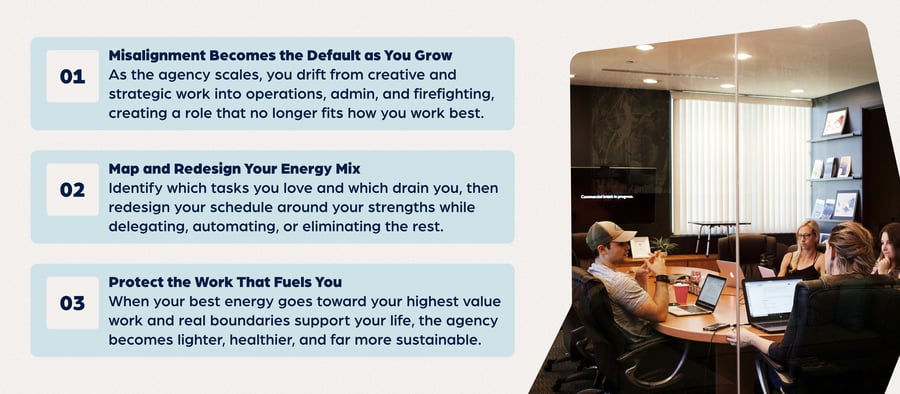
How Misalignment Becomes the Default
Most owners do not intentionally build a role that burns them out. Misalignment usually happens slowly.
You start by doing work you enjoy. The business grows. More clients arrive. You hire. You add processes and structure. Growth looks positive from the outside.
But with each phase of growth, new responsibilities appear:
- Hiring and managing team members
- Handling operations and delivery issues
- Overseeing finances and cash flow
- Managing client escalations and expectations
- Dealing with constant communication and admin
Without realizing it, you move further away from the strategic and creative work that made you want an agency in the first place. The work you love becomes a small slice of your week, while the work you tolerate or dislike takes over.
Even when the agency looks successful on paper, you feel overwhelmed, disconnected or resentful. The issue is not that you are not capable. The issue is that your role no longer matches how you are wired to work.
Map Your Energy with the Four Quadrants Exercise
To regain control, you first need clarity about where your energy is going.
Create four categories:
- Great at it and love it.
- Good at it and like it.
- Okay at it and dislike it.
- Bad at it and hate it.
Now list every recurring task you handle in the business. For example:
- Sales and discovery calls.
- Client strategy and direction.
- Creative reviews.
- Team meetings and 1:1s.
- Financial reviews and decisions.
- Project management.
- Inbox and client communication.
- Admin, invoicing and collections.
- Operations, capacity and process work.
Place each task into the category where it truly belongs.
Most owners quickly see that:
- The work they love takes up the least time.
- The work they dislike or hate takes up a lot of space.
This simple exercise gives you an honest picture of why your days feel the way they do. It also becomes the roadmap for what needs to change.
Build a Burnout Map for Your Week
Once you know which tasks fuel you and which drain you, look at when they are happening in your week.
Review a typical week and ask:
- When do I do my highest energy work?
- When do I do my lowest energy work?
- When do unexpected fires usually show up?
- How often am I switching between task types?
Many agency owners discover that:
- Draining tasks are scattered throughout every day.
- Creative or strategic work is squeezed into leftover time.
- Calls and meetings interrupt deep focus.
Instead of allowing your week to happen to you, begin to intentionally design it around your energy.
You might decide to:
- Protect mornings for strategy and high value creative work.
- Batch admin tasks into one or two blocks per week.
- Limit client calls to specific days or time windows.
- Assign finance or operations work to a single weekly block.
The goal is to group similar work together and protect your best energy for what you do best. This alone can dramatically change how your days feel.
Delegate, Automate or Eliminate the Right Work
Restructuring your schedule helps, but the deeper solution comes from removing the wrong work from your plate altogether.
For each task in the “okay and dislike” or “bad and hate” categories, ask three questions:
- Can this be delegated?
- Can this be automated?
- Can this be eliminated?
Delegation works well for tasks like:
- Routine client communication and updates
- Gathering assets and information
- Project tracking and status management
- Compiling reports once the structure is defined
Automation is ideal for:
- Client onboarding steps
- File and folder creation
- Standard email sequences
- Tool integrations and notifications
Elimination applies to tasks that no longer serve a real purpose, such as:
- Reports no one reads
- Internal meetings with no clear outcome
- Manual checks that could be replaced by better systems
Every task you delegate, automate or eliminate frees capacity and reduces the daily energy drain that leads to burnout.
Protect Your Zone of Genius Without Losing Your Life
As you shift more of your time into energizing work, you will feel the difference quickly. Your focus improves. You feel more creative. You enjoy the business more.
However, there is a hidden risk here. When work finally feels good again, it can be tempting to fill every spare moment with more of it. You work later. You work on weekends. You tell yourself you are just taking advantage of momentum.
Your agency will always accept more of your time. But if you allow it to expand into every corner of your life, you create a different kind of problem. Your energy may be high, but your life becomes one dimensional.
To avoid this, create clear boundaries:
- Decide how many hours you are willing to work each week.
- Choose which evenings are non negotiable personal time.
- Protect activities that matter outside of work, such as family, health or hobbies.
Your energy is not just for the business. It is for you.
How to Put This Into Practice
Burnout is not a personal failure. It is a signal that your current role is misaligned with your strengths and your energy.
You can change that.
Start here:
- Map your tasks into the four quadrants honestly.
- Identify which tasks are draining the most energy.
- Reorganize your week so your best energy goes to your best work.
- Delegate, automate or eliminate the tasks that do not fit you.
- Protect time for strategy and creative direction.
- Set and honor boundaries around your working hours.
You do not need a perfectly balanced life. You need a role and schedule designed intentionally around how you work best.
When your agency is built around your strengths instead of your tolerance, the business becomes lighter, more profitable and more sustainable. Burnout becomes something you can prevent, and you reconnect with the work that inspired you to start your agency in the first place.