


Most creative agencies do not struggle because of a lack of talent.
They struggle because they are constantly sacrificing something.
They push for speed and quality drops.
They chase perfect quality and timelines explode.
They try to do everything at once and the team burns out.
At first, these tradeoffs feel temporary. Just get through this launch. Just push a little harder this quarter. Just say yes to this one client.
But over time, the pattern becomes permanent.
Projects feel heavier. Delivery feels harder than it should. Margins quietly shrink. The owner becomes the glue holding everything together, jumping from client conversations to internal fixes to late-night problem solving.
This is not because the agency lacks discipline or ambition. It is because the agency is operating without a system that protects what actually drives profitability.
Healthy, profitable creative agencies do not rely on hustle or heroic effort. They rely on structure.
When quality, speed, and team wellbeing are intentionally balanced, everything changes. Operations smooth out. Delivery becomes predictable. Teams regain energy. Margins stabilize. And the agency stops feeling like it is one missed deadline away from chaos.
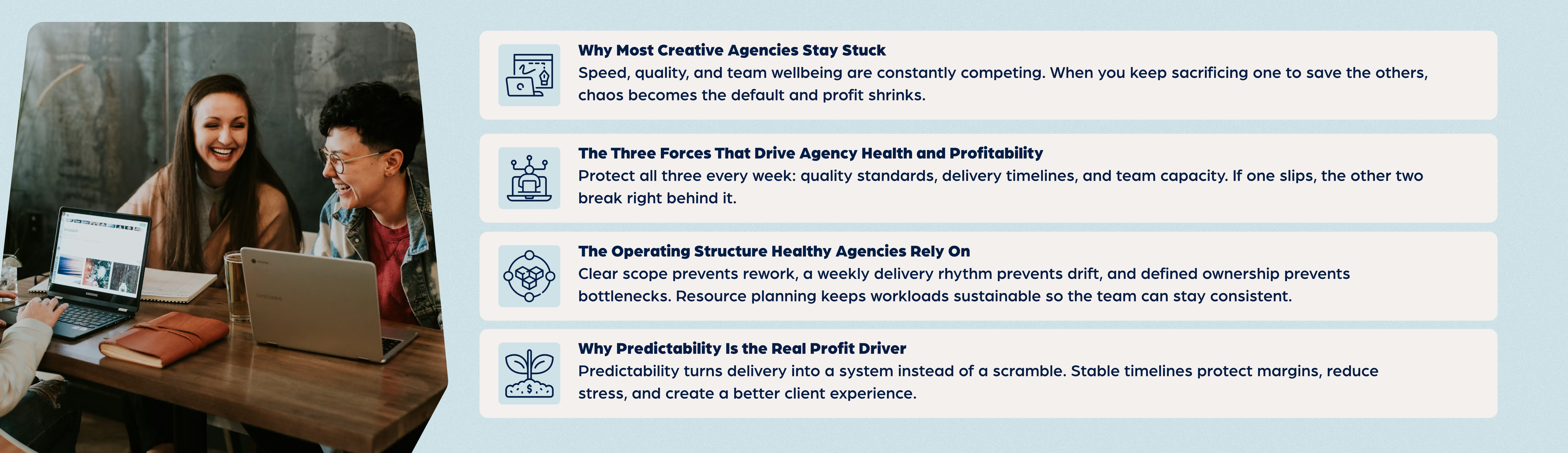
Why Most Creative Agencies Stay Stuck
Creative agencies live inside constant tension.
Clients want work faster than feels reasonable.
Owners want to protect the quality of what they put into the world.
Teams need sustainable workloads to do their best work.
Most agencies unknowingly over-prioritize one of these at the expense of the others.
Some agencies obsess over speed. They promise aggressive timelines, compress schedules, and celebrate being “fast.” Over time, quality slips. Revisions increase. Teams feel rushed and undervalued. The work technically gets done, but it no longer feels thoughtful or inspired.
Other agencies swing the opposite direction. They chase perfect quality. Every detail is refined. Every idea is explored. Timelines stretch. Projects pile up. Clients get anxious. Cash flow becomes unpredictable. What started as craftsmanship turns into delay.
Then there are agencies that try to maximize both speed and quality without adjusting capacity. This is where burnout takes hold. Teams work nights and weekends. Owners fill gaps personally. Short-term results mask long-term damage.
This is not a motivation problem. It is an operating system problem.
Without a clear framework, agencies default to reactive decision-making. Everything feels urgent. Every issue is handled in isolation. And reaction is one of the most expensive ways to run a business.
The Three Forces That Drive Agency Health and Profitability
Every creative agency, regardless of size or specialty, is governed by the same three forces.
Quality is the standard of work delivered to clients. It includes creative execution, strategic thinking, consistency, and the overall experience of working with your agency.
Speed is how reliably work moves from kickoff to completion. Not how fast projects start, but how predictably they finish.
Team wellbeing is the energy, capacity, and morale of the people doing the work. This determines how consistently quality and speed can be maintained over time.
All three directly affect profitability. When one breaks, the others follow.
When quality breaks down, the symptoms are immediate. Clients push back. Feedback becomes vague. Revisions increase. Scope creep sneaks in because teams try to “make it right” after the fact. Rework replaces forward progress, and timelines quietly slip as a result.
When speed breaks down, the financial impact shows up quickly. Late projects clog the pipeline. Billing gets delayed. Cash flow becomes unpredictable. Referrals slow because delivery feels unreliable. On average, every week a project goes overdue erodes margins by roughly 6%. For many agencies operating at thin margins, just a few late weeks are enough to erase profit entirely.
When team wellbeing breaks down, the damage is more subtle but far more expensive. Burnout leads to inconsistency. Turnover increases. Knowledge walks out the door. Leaders are pulled back into training, onboarding, and damage control. Quality drops. Speed slows. Clients feel the shift even if they cannot articulate it.
Your product is your team’s talent, time, and attention. When that deteriorates, everything else does too.
Why Profitability Erodes Without Obvious Red Flags
Most agencies do not wake up one day and realize they are unprofitable. It happens gradually, through a series of small operational leaks.
Unclear project scope leads to over-servicing. Teams are unsure where work begins and ends, so they keep going. Extra rounds. Extra deliverables. Extra effort that never gets billed.
Lack of delivery rhythm creates constant urgency. Without a predictable cadence, work piles up unevenly. Some weeks feel light. Others feel impossible. Everything becomes a rush, even when it should not be.
Founders either micromanage or disengage. Some owners stay too close to every detail, becoming a bottleneck. Others step back completely, assuming the team will “figure it out.” In both cases, accountability breaks down.
Each of these issues feeds directly into quality problems, speed problems, and morale problems. Those problems then show up as profitability problems.
Busy does not mean healthy. Full calendars do not guarantee profit. Activity without structure is one of the most dangerous states an agency can be in.
The Operating Structure Healthy Agencies Rely On
Agencies that remain profitable long term do not rely on individual effort. They rely on structure that protects quality, speed, and team wellbeing at the same time.
Clear project scoping is the first layer. When scope is well-defined, everyone understands what is included, what is excluded, and where work begins and ends. This clarity protects quality by giving teams a clear target. It protects speed by reducing rework and renegotiation mid-project. Ambiguity is expensive. Clarity is profitable.
A predictable delivery rhythm is the second layer. Speed does not come from rushing. It comes from rhythm. Healthy agencies define how work moves, how decisions are made, and how communication flows. Weekly planning creates alignment. Mid-week check-ins prevent drift. End-of-week reviews surface issues before they compound. The further ahead the agency can see, the fewer surprises it faces.
Role clarity is the third layer. When ownership is unclear, work stalls. When ownership is clear, momentum builds. Clear responsibility allows team members to take accountability without waiting for permission. Decision-making improves. Hand-offs clean up. Leaders spend less time chasing updates and more time guiding strategy.
Resource planning is the final layer. Burnout rarely comes from one hard week. It comes from sustained overload without visibility. Resource planning makes capacity visible. Leaders can see where attention is going, anticipate overload, and make informed decisions about new work. Balanced workloads protect morale, retention, and quality.
Together, these systems create rhythm. And rhythm creates predictability.
Why Predictability Is the Real Profit Driver
There is a direct relationship between rhythm, predictability, and profit.
Predictable delivery protects timelines.
Timelines protect margins.
Margins reduce stress and create opportunity.
When work flows consistently, billing stabilizes. Clients trust the process. Teams feel less reactive. Leadership regains clarity.
Chaos is expensive. Predictability is profitable.
Agencies that feel calm on the inside almost always perform better on the outside. Not because they work less, but because their effort is applied intentionally instead of reactively.
How to Spot Problems Before They Become Expensive
Most agency owners notice issues and act too late. The key is catching the early signals before they compound.
Watch for emotional exhaustion across the team. When energy drops and frustration rises, something in the system is off.
Notice slow internal approvals and recurring bottlenecks. These often point to unclear ownership or founder dependency.
Pay attention to constant emergency mode. When everything feels urgent, nothing is being managed predictably.
Track margins honestly. Net profit below 20 percent after owner compensation is a warning sign, not a benchmark.
Look for low creative energy. Creative work requires space. When creativity dries up, burnout is already present.
These are not people problems. They are system problems.
Putting This Into Practice
Balancing quality, speed, and team wellbeing is not a one-time fix. It is an operating discipline.
Start by tightening project scope so expectations are clear from day one.
Establish a delivery rhythm that makes progress visible and predictable.
Define ownership so accountability is shared, not centralized.
Plan resources so workload stays sustainable.
When these systems are in place, agencies become calmer, more profitable, and easier to manage. Clients are happier. Teams stay engaged. Margins stabilize. And the owner regains time to lead instead of firefighting.
Running a profitable, healthy creative agency starts with balancing quality, speed, and wellbeing.