


Most creative agency owners know the feeling.
You land a great project. The client is thrilled with the work. Your team delivers exceptional results. Revenue comes in, and things feel stable for a moment.
Then the project ends.
Suddenly, your attention shifts from delivery back to business development. You start wondering where the next project will come from, whether your pipeline is healthy enough, and if the revenue forecast you built a month ago is still realistic.
For many agencies, this cycle never stops.
The problem is not poor work. It is not unhappy clients. In many cases, agencies are producing incredible results. The challenge is that the business model itself is creating instability. When revenue depends entirely on projects, the business effectively resets every few months, forcing owners to constantly chase the next opportunity.
This creates what many agency owners experience as the 90-day revenue cliff.
The good news is that the most stable agencies have found a way to escape it.
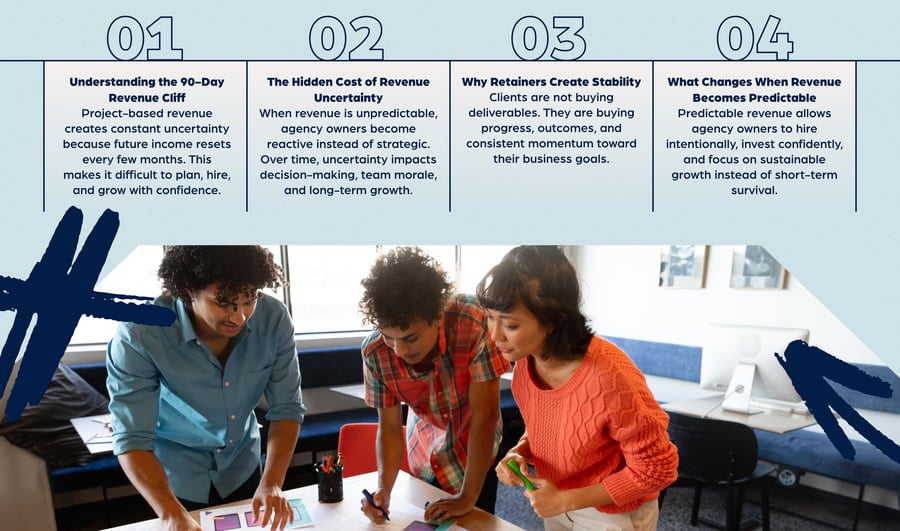
Understanding the 90-Day Revenue Cliff
Project-based work can be highly profitable, but it comes with a hidden challenge. Revenue visibility is often limited to the duration of current engagements. Whether projects last one month, three months, or six months, most agency owners struggle to see far enough into the future to make confident decisions.
As a result, every leadership decision gets filtered through uncertainty.
Instead of asking how to sustainably grow the business, owners find themselves asking:
- Can we afford another hire?
- Should we invest in new systems?
- What happens if we don't close another project next month?
- Can we maintain payroll if a client delays signing?
- One package may help the client achieve their objective over a longer timeline.
- Another may accelerate results through increased strategic involvement.
- A premium option may combine multiple services to maximize speed and impact.
- What are your goals over the next six to twelve months?
- What challenges do you anticipate as the business grows?
- What opportunities are you trying to capitalize on?
- Where do you need support to maintain momentum?
Even during strong months, there is often an underlying anxiety because future revenue is never guaranteed.
The reality is that many agency owners spend more time managing uncertainty than executing growth strategies.
Why Some Agencies Stay Project-Based
To be fair, project work is not inherently bad.
In fact, there are benefits that attract agency owners to this model in the first place. Project-based environments often create urgency, momentum, and a strong performance culture. Teams remain focused because there is always a new challenge to solve and another opportunity to pursue.
Some agencies genuinely thrive in this environment, especially those operating in industries where projects are naturally the preferred engagement model.
However, the same characteristics that create energy can also create long-term strain.
When the pressure to replace revenue never disappears, agency owners become trapped in a cycle of constant reaction. Growth becomes harder because every decision must account for the possibility of future instability.
The Hidden Cost of Revenue Uncertainty
The biggest danger of project-based revenue is not financial.
It is operational.
When agency leaders cannot confidently predict revenue, they tend to become reactive across every area of the business. Hiring decisions get delayed. Investments in systems are postponed. Pricing becomes inconsistent. Strategic planning gets replaced with short-term survival.
Over time, this creates a business that feels stuck.
Many agency owners reach a point where they are working harder than ever, yet still feel unable to build the stability they originally wanted when starting their agency.
The impact extends beyond leadership as well.
When uncertainty becomes part of the company culture, team members begin to feel it. They notice sudden hiring freezes. They experience layoffs during slow periods. They sense the stress that leadership is carrying.
As confidence decreases, morale often follows.
A business built around constant uncertainty eventually becomes exhausting for everyone involved.
Why Retainers Create Stability
The strongest agencies understand something important.
Clients are rarely buying deliverables.
They are buying progress.
This distinction changes everything.
Many agency owners attempt to sell retainers by focusing on monthly outputs. They talk about the number of blog posts, social media assets, design revisions, or strategic meetings included in the package.
But clients do not wake up wanting more deliverables.
They want solutions.
They want growth.
They want outcomes.
The agencies that successfully transition to recurring revenue structure their offers around solving ongoing problems rather than delivering recurring tasks.
Instead of selling activity, they sell advancement.
Instead of selling deliverables, they sell momentum.
This shift allows clients to see the long-term value of maintaining an ongoing relationship rather than viewing the engagement as a one-time transaction.
Building Retainers Around Outcomes
One of the most effective ways to structure a recurring offer is to focus on the destination your client wants to reach.
Rather than asking, "What services do we provide each month?" ask a different question:
"What result is the client trying to achieve?"
Once that outcome is clear, you can position different service levels around the speed and support required to reach that goal.
For example:
Each package solves the same problem.
The difference is how quickly and effectively the client arrives at the desired outcome.
This approach helps shift conversations away from cost and toward value.
When clients understand the business impact of the work, pricing becomes far easier to justify.
Your Existing Clients Are Your Best Opportunity
One of the biggest misconceptions agency owners have about retainers is that they are difficult to sell.
In reality, your easiest retainer sale is often sitting right in front of you.
Existing clients already trust you.
They know your team.
They have experienced your process.
Much of the work required to build credibility has already been completed.
Unlike new prospects, you do not need extensive qualification calls or lengthy trust-building conversations. Instead, you simply need to understand where the client wants to go next.
After completing a project, ask questions like:
These conversations naturally reveal opportunities for ongoing partnerships.
Most businesses do not solve all their challenges with a single project. As they grow, new obstacles emerge. New priorities develop. New opportunities appear.
Because you have already helped them achieve one objective, you are often in the best position to help them achieve the next one.
What Changes When Revenue Becomes Predictable
The greatest benefit of recurring revenue is not simply higher revenue.
It is better decision-making.
When agency leaders can see beyond the next 90 days, everything changes.
Hiring becomes intentional rather than reactive. Investments become strategic instead of risky. Growth plans become achievable because they are built on predictable revenue rather than optimistic assumptions.
You begin leading from confidence instead of fear.
That does not mean new business development disappears. Agencies with recurring revenue still pursue new opportunities and continue growing their client base.
The difference is that every new client becomes an opportunity to strengthen an already stable foundation rather than a desperate attempt to replace lost revenue.
That shift creates a healthier business, a stronger team, and a more sustainable future.
How to Start Making the Transition
Moving from project-based revenue to recurring revenue does not require rebuilding your agency overnight.
Start by identifying where your clients need ongoing support after a project is complete.
Look for recurring problems that require consistent attention.
Package your expertise around outcomes instead of deliverables.
Most importantly, begin having strategic conversations with your current clients about what success looks like beyond the project they hired you for today.
The agencies that create lasting growth are not necessarily the ones that land the biggest projects.
They are the ones that build systems for predictable revenue, sustainable profitability, and long-term client relationships.
When you eliminate the 90-day revenue cliff, you gain something far more valuable than recurring income.
You gain the clarity, confidence, and freedom needed to build an agency that serves your life instead of controlling it.