
If you have ever hired an exceptional team member, you know just how transformational the right person can be for your agency. A strong hire can improve client delivery, elevate team morale, create operational stability, and free you from becoming the bottleneck in your business.
Unfortunately, the opposite is also true.
Many agency owners assume their biggest growth challenges come from difficult clients, inconsistent sales, or changing market conditions. While those issues certainly create obstacles, some of the most expensive problems inside an agency start with hiring decisions.
The true cost of a bad hire extends far beyond salary. It shows up in lost productivity, frustrated team members, declining client experiences, and countless hours spent fixing mistakes that should never have happened in the first place. For agencies trying to grow sustainably, these hidden costs can significantly slow growth and create unnecessary stress.
The good news is that most hiring mistakes are preventable when you build the right systems around your recruitment and onboarding process.
Here are the five most costly hiring mistakes creative agency owners make and how to avoid them.
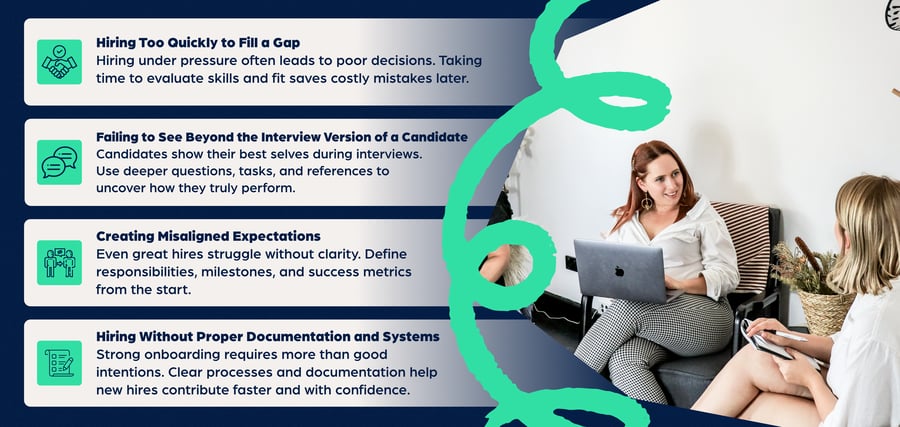
1. Hiring Too Quickly to Fill a Gap
When workload increases and your team feels stretched thin, it is tempting to hire the first qualified candidate who appears capable of solving the problem. Unfortunately, urgency often leads to poor decision-making.
Many agency owners hire from a place of desperation rather than strategy. They focus on filling the role quickly instead of ensuring the person is truly the right fit. While this may temporarily relieve pressure, it often creates larger problems several months later when performance issues begin to surface.
A rushed hiring process can result in:
- Hiring someone who lacks critical skills
- Bringing in a poor cultural fit
- Creating additional management challenges
- Restarting the hiring process after a failed hire
- How they handled pressure
- How they interacted with clients
- How they collaborated with team members
- How they responded to feedback and challenges
- Key responsibilities
- Performance milestones
- Expected outcomes
- Communication standards
- Standard operating procedures
- Role responsibilities
- Workflow processes
- Client communication standards
Instead of rushing, create a system that allows you to build a candidate pipeline before you desperately need someone. This gives you the flexibility to evaluate multiple candidates and make thoughtful decisions. Also have a contractor pool for overflow needs that allows you to alleviate pressure while you get new hires onboarded.
One of the most effective ways to assess potential hires is through a real-world task. Rather than relying solely on interviews, give candidates a practical assignment that mirrors the type of work they would perform inside your agency.
The goal is not simply to evaluate execution. It is to understand how they think, solve problems, and approach decision-making. Those insights often reveal far more than a resume ever could.
2. Failing to See Beyond the Interview Version of a Candidate
Every candidate presents the best version of themselves during the hiring process. Interviews are designed environments where people naturally highlight their strengths and minimize their weaknesses.
This means your responsibility as a hiring manager is not simply to evaluate the person in front of you. It is to understand who they are when the interview is over.
Many agency owners avoid asking difficult follow-up questions because they fear creating discomfort. In reality, deeper conversations often reveal the information you need to make confident hiring decisions.
When discussing previous projects or client engagements, ask candidates to explain their role in detail. Strong performers can clearly articulate their process, decision-making, and contributions. They understand not only what was done but why it was done.
At Creative Agency Success, we often see agency owners uncover valuable insights simply by digging deeper into specific examples rather than accepting surface-level answers. All true practitioners can go into an incredible amount of detail; if they know what they are doing, you must be confident that your new hire can do the job well.
Reference checks are equally important. However, many business owners only ask about performance. To gain a more complete picture, ask questions about character and behavior.
Consider exploring topics such as:
Understanding these traits often provides greater predictive value than technical skills alone.
3. Creating Misaligned Expectations
One of the fastest ways to lose a great hire is to place them in an environment where success is unclear.
High performers want to do exceptional work. They want to contribute, grow, and create meaningful impact. However, even the strongest employee will struggle if they do not understand what success looks like.
Many agencies unintentionally create confusion by providing vague responsibilities, unclear priorities, or inconsistent feedback. When expectations are ambiguous, team members are forced to guess what matters most.
This uncertainty creates frustration and eventually leads to disengagement.
Instead, define success as clearly as possible.
Every role should include measurable responsibilities, clear outcomes, and specific performance expectations. New hires should understand exactly what is expected during their first 30, 60, and 90 days.
The most effective onboarding plans create alignment around:
When team members know exactly how success is measured, they gain confidence and can focus their energy on delivering results rather than interpreting expectations.
4. Ignoring Cultural Alignment
Many agency owners prioritize skills while overlooking culture.
Technical ability matters. However, even the most talented individual can create significant challenges if their values and behaviors conflict with the rest of the team.
Poor cultural alignment often creates friction that spreads throughout the organization. Communication breaks down. Collaboration becomes difficult. Team morale suffers. Then Client experiences are impacted.
The reality is that skills can often be developed over time. Cultural fit is much harder to change.
This is why culture should be evaluated intentionally throughout the hiring process.
Before interviewing candidates, define your agency's core values and operating principles. Then build interview questions that specifically assess those characteristics.
Many successful agencies structure hiring around multiple stages. An initial culture interview helps determine alignment before moving candidates into deeper role-specific evaluations. This approach saves time and improves hiring accuracy.
When new team members understand and embrace your culture, they integrate more effectively, contribute more quickly, and strengthen the overall agency environment.
5. Hiring Without Proper Documentation and Systems
One of the biggest onboarding mistakes agencies make is assuming new hires will simply figure things out.
Every new employee enters your organization looking for clarity. They want to understand how work gets done, where to find information, and what success looks like.
Without proper documentation, confusion becomes inevitable.
The consequences extend beyond the new hire. Existing team members are constantly interrupted for answers. Productivity decreases. Frustration increases. Both the new employee and the current team feel the strain.
This is why documentation acts as a force multiplier within growing agencies.
Your onboarding process should include documented systems for:
When every new hire receives the same information and guidance, they can become productive far more quickly.
Strong documentation also builds confidence. Instead of feeling lost or dependent on others, new employees gain the resources they need to contribute independently.
A strong start creates sustainable growth.
How to Build a Stronger Hiring Process
Avoiding hiring mistakes is not about finding perfect candidates. It is about creating a repeatable system that consistently identifies the right people and sets them up for success.
If you want to strengthen your hiring process, focus on these five areas:
- Slow down and avoid hiring from desperation.
- Look beyond interviews and validate candidates through practical tasks and references.
- Create crystal-clear expectations for every role.
- Evaluate cultural alignment with the same rigor as technical skills.
- Build documentation and onboarding systems that support long-term success.
The agencies that grow successfully are not necessarily the ones with the most talent. They are the ones with the strongest systems for attracting, developing, and retaining that talent.
Every hiring decision shapes your culture, your client experience, and your future growth. By approaching hiring strategically rather than reactively, you create a stronger foundation for sustainable profitability, greater team performance, and the freedom every agency owner is ultimately working toward.