
Every creative agency has talent. Strong ideas. Capable designers. Strategic thinkers who know how to solve real client problems.
And yet, growth still stalls.
From the outside, things look fine. Clients are happy. Work is getting delivered. Revenue is coming in. But internally, projects feel heavier than they should. Decisions take too long. The founder is still involved in everything. And growth feels harder than expected.
What holds most agencies back is not a lack of talent. It is the blind spots you do not realize are there.
These blind spots quietly weaken execution, slow teams down, and cap growth even when the agency appears healthy. We see them across small teams and multi seven figure agencies alike.
Once you fix these blind spots, everything changes. Your team moves faster. Your work gets clearer. And you finally stop being the bottleneck holding everything together.
Here are the five blind spots we see most often inside creative agencies and how to eliminate them.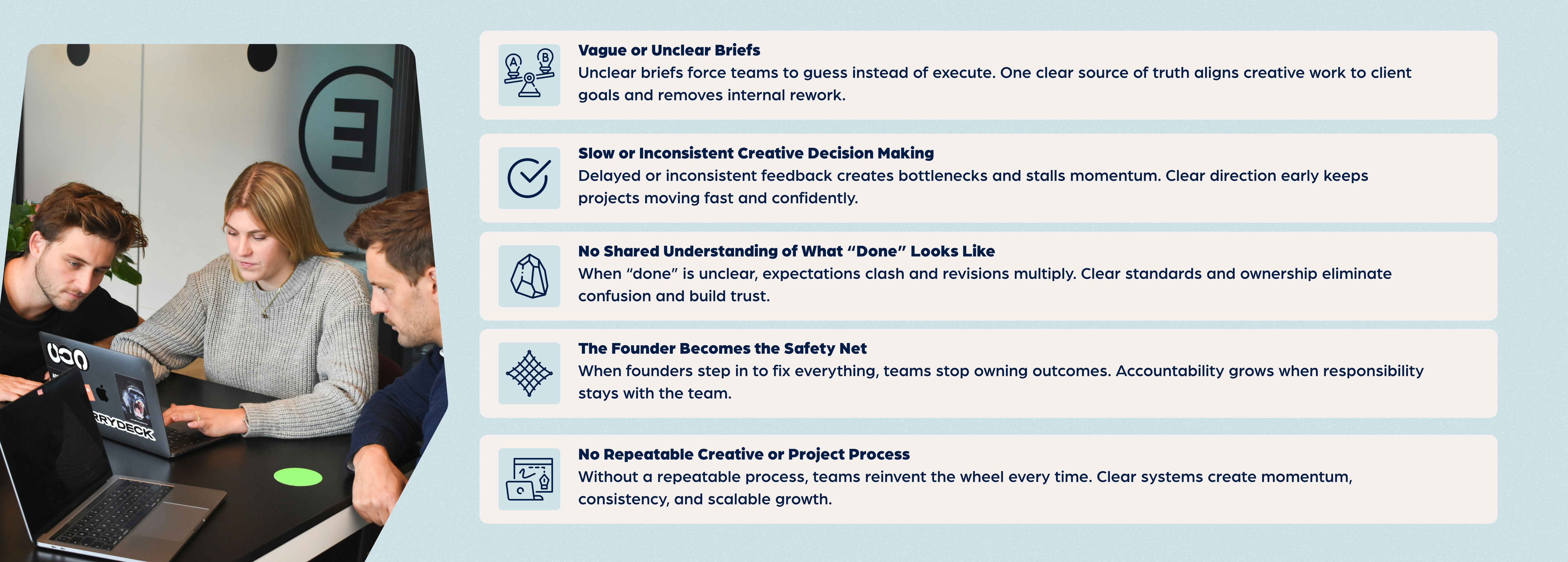
Vague or Unclear Briefs
If your team is constantly revising work internally before it ever reaches the client, this is almost always the root cause.
Unclear briefs create guesswork.
When expectations live across Slack messages, kickoff calls, Notion docs, and half remembered conversations, your team is forced to interpret instead of execute. Everyone fills in the gaps differently. That is when revisions explode.
This is not about client feedback. It is about internal rework. Late nights. Weekend fixes. Leadership stepping in to redirect work that should have been clear from the start.
The fix is not more documentation. It is one clear source of truth.
Every project needs a single brief that includes the core objective, the big idea, reference points and inspiration, success criteria, and context for why the work matters.
But clarity goes deeper than checklists.
Your team must understand how the creative idea directly supports the client’s goals. When people understand where they are headed and why it matters, they stop guessing and start executing with confidence.
Without that clarity, founders end up deeply involved in every stage of the project or paying for it later through endless revisions. Neither option scales.
Slow or Inconsistent Creative Decision Making
This blind spot almost always shows up at the leadership level.
Most often, it is the founder or creative director who unintentionally becomes the bottleneck. Decisions stall. Feedback feels inconsistent. Projects slow down while the team waits for direction.
This usually comes from one of two problems.
The first is over communication. Too much feedback, too frequently, without clear direction. The team reacts to every comment instead of moving forward. Momentum dies in the back and forth.
The second is under communication. Leadership is hands off early, the team heads in the wrong direction, and feedback arrives too late. Fixing it becomes expensive and frustrating.
Strong creative leadership follows a rhythm.
Most alignment should happen at the beginning of a project. Roughly 60 percent of creative and strategic direction belongs at kickoff. This is where direction gets locked.
There should be a lighter check in around the midpoint to confirm alignment.
Then a near final review around 75 percent completion to elevate the work and push it across the finish line.
If a project starts off course, every step forward makes correction harder. When direction is locked early, everything downstream becomes easier.
No Shared Understanding of What “Done” Looks Like
One of the most common sources of frustration inside agencies is misalignment around completion.
Different people have different ideas of what finished means. When that is not clearly defined, teams deliver work they believe is complete, only to be told it missed the mark.
This is not a talent issue. It is a delegation issue.
Every task carries a level of authority, but that level is rarely stated explicitly.
Do you want raw research only. Do you want research plus a summary. Do you want conclusions and recommendations. Do you want a full solution with next steps. Or do you want full ownership with a simple status update.
Each requires a different level of thinking and responsibility. When that is unclear, people default to the safest option.
True alignment requires clarity in three areas. What is being delivered. What quality looks like. Why the solution works.
Your team should be able to explain their rationale, not just present output. When reasoning is missing, trust breaks down and revisions multiply.
Clear expectations reduce friction and build confidence on both sides.
The Founder Becomes the Safety Net
This blind spot is uncomfortable because it is usually self created.
When founders constantly step in to fix mistakes, catch errors, or save projects at the last minute, they train the team not to own the outcome.
Tasks get checked off, but problems remain. Small issues slip through. And leadership absorbs the responsibility every time.
This happens because founders feel the weight of ownership. If something goes wrong, they believe it is on them. So they step in and fix it.
But that behavior creates the wrong incentive.
When leadership always saves the day, the team never feels the full responsibility of delivery. Growth stalls. The founder stays overloaded. The team stays dependent.
Real accountability requires letting people fix their own mistakes.
That means clear SOPs, checklists, and expectations paired with real ownership. When people are responsible for outcomes, not just tasks, they grow faster and deliver better work.
Stop being the hero. Give your team the space to step up.
No Repeatable Creative or Project Process
Many agencies defend chaos by saying every project is different.
While each project has unique elements, the reality is that patterns exist across nearly all work. Ignoring those patterns prevents scale.
Without a defined process, there is no rhythm. No operational memory. No consistency. Teams reinvent the wheel on every project, and leadership becomes the glue holding everything together.
Strong agencies build delivery systems.
That means defined project phases, repeatable workflows, clear handoffs, standard templates, and a predictable rhythm of execution.
Systems do not limit creativity. They protect it.
When operations are stable, creative energy can focus on solving problems instead of fighting fires. Without systems, chaos fills the gap and growth hits a ceiling.
How to Start Fixing These Blind Spots Inside Your Agency
Once you identify these blind spots, you will notice immediate shifts.
Projects move faster.
Work gets clearer.
Your team becomes more confident.
And you are no longer needed in every decision.
To implement this inside your agency, start here.
Audit your briefing process and create one clear source of truth.
Define decision making rhythms for every project.
Clarify what “done” looks like before work starts.
Remove yourself as the safety net and reinforce ownership.
Document and standardize your delivery process.
Fixing blind spots is only the beginning. To sustain better creative work, you need a delivery system strong enough to support it. One that allows your agency to operate smoothly, scale responsibly, and grow without chaos.