

You started your agency because you were great at what you do.
Your creative expertise, attention to detail, and commitment to clients helped you build something from the ground up. Every project, every client relationship, and every important decision flowed through you. In the early stages, that level of involvement was often necessary because your standards were what made the agency successful.
But something changes as an agency grows.
Instead of gaining more freedom, many agency owners find themselves carrying even more responsibility. Team members need approval before moving forward. Clients expect direct access to the founder. Quality control becomes dependent on one person. Vacations become stressful, and every day feels like a constant stream of decisions that only you can make.
At first, this level of involvement feels responsible. Eventually, it becomes one of the biggest obstacles to growth.
Founder dependency is one of the most common reasons creative agencies struggle to grow. It limits revenue, prevents team development, reduces business value, and keeps owners trapped in the day-to-day operations they hoped to escape.
The good news is that founder dependency can be fixed. The first step is understanding exactly how it shows up inside your agency.
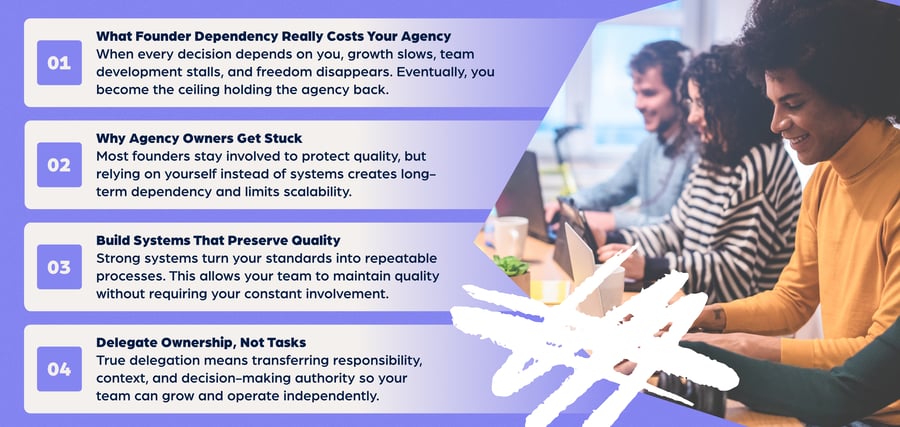
What Founder Dependency Really Costs Your Agency
Many agency owners assume their involvement protects quality and ensures clients receive the best experience possible.
While that may be true initially, there comes a point where founder involvement creates more problems than it solves.
When every important decision requires your approval, the agency's growth becomes tied directly to your capacity. There are only so many hours in a day, and eventually your ability to make decisions becomes the limiting factor for the entire organization.
This often creates several challenges at the same time:
- Revenue growth slows because the owner becomes the bottleneck.
- Team members struggle to develop confidence and leadership skills.
- Clients become dependent on the founder rather than the agency.
- The owner feels unable to take meaningful time away from the business.
- Client management
- Operations
- Creative delivery
- Finance
- Team management
- Standard operating procedures
- Creative briefs
- Quality control checklists
- Feedback frameworks
- Escalation processes
For agencies that may eventually be sold, founder dependency creates an additional challenge. Buyers place significant value on businesses that can operate independently. When the agency relies heavily on the founder's involvement, the perceived risk increases and valuation often decreases.
Perhaps the most overlooked cost is the impact on the owner's well-being.
Being the person everyone depends on can feel rewarding for a while. Over time, however, it becomes exhausting. Constant decision-making, problem-solving, and client management create a level of pressure that is difficult to sustain long-term.
The business starts serving itself instead of serving the life you wanted to build.
Why Agency Owners Get Stuck
Most founders do not intentionally create dependency.
In fact, many are simply trying to protect the business.
They tell themselves that nobody can do the work quite as well as they can. They worry that quality will suffer if they step back. They fear disappointing clients or creating unnecessary mistakes.
In many cases, those concerns are valid.
The issue is not that founders care too much. The issue is that they often try to solve every problem through personal involvement rather than through systems.
When standards only exist inside your head, your team has no choice but to come to you for answers. When processes are undocumented, your judgment becomes the process. Over time, you become the glue holding everything together.
The challenge is not your team's inability to perform.
The challenge is that the business was never designed to operate without you.
Shift Your Role From Doer To Builder
One of the most important mindset shifts an agency owner can make is recognizing that your job is no longer to be the best at every function.
Your responsibility is to build an organization that consistently performs at a high level.
That means creating systems that allow other people to succeed.
Many founders assume that their judgment is impossible to replicate. In reality, much of what feels like intuition is simply pattern recognition built through experience. While experience cannot be transferred overnight, much of that knowledge can be documented, taught, and reinforced through process.
Strong agencies do not rely on founder presence for consistency.
They rely on clear standards, documented expectations, and empowered team members who understand how decisions should be made.
The goal is not to make yourself unnecessary.
The goal is to make your involvement optional.
Start By Identifying Where You Are The Bottleneck
Before you can remove founder dependency, you need visibility into where it exists.
For one week, pay close attention to every decision that requires your involvement. Keep a simple list and record every situation where someone comes to you for approval, direction, or problem-solving.
As you review the list, categorize each decision by function:
Once you have visibility into these areas, ask yourself two questions.
First, which decisions truly require your expertise?
Second, which decisions could be handled by someone else if they had the proper guidance, training, or documentation?
Many founders are surprised to discover how many responsibilities remain on their plate simply because they have never intentionally transferred ownership.
Identifying these opportunities is often the fastest way to create capacity.
Build Systems That Preserve Quality
One of the biggest fears agency owners have about delegation is losing quality.
The solution is not staying involved forever.
The solution is creating systems that preserve standards.
If your agency consistently produces high-quality work, there is usually a repeatable process behind that success. The challenge is getting that process out of your head and into a format that others can follow.
This can include:
The goal is not to document every possible scenario. Instead, focus on the 80% to 90% of situations that happen repeatedly.
When unusual situations arise, team members can escalate appropriately. But the majority of decisions should no longer require founder involvement.
The more clarity your team has, the more confidently they can operate without you.
Delegate Ownership, Not Tasks
Many delegation efforts fail because founders hand off tasks while retaining responsibility.
True delegation means transferring ownership.
Ownership requires context. Team members need to understand not only what they are doing but why it matters and how success is measured.
When people understand the outcome they are responsible for, they become capable of making decisions independently.
This process also requires patience.
Mistakes will happen.
Every successful agency leader can point to lessons learned through experience. Your team develops judgment in exactly the same way. Small mistakes, handled in a safe environment, become valuable learning opportunities that strengthen decision-making over time.
If founders constantly step back in to rescue every situation, that growth never occurs.
Great leaders coach through mistakes rather than preventing every mistake from happening.
How To Remove Yourself From The Day-To-Day
Removing founder dependency is not a single event.
It is a gradual process.
Start with one area of responsibility that feels relatively low risk. This might be client communication, project management, or a recurring operational process.
Give someone ownership.
Provide coaching.
Review outcomes.
Offer feedback.
Then gradually reduce your involvement.
As confidence grows, encourage that team member to document and improve the process themselves. This creates another layer of ownership while strengthening your operational foundation.
Over time, successful handoffs create momentum. Your team becomes more capable, your systems become stronger, and your involvement becomes increasingly focused on strategic growth rather than daily execution.
Build An Agency That Creates Freedom
The strongest agencies are not built around a founder's constant presence.
They are built around systems, standards, and teams that can perform consistently without requiring daily intervention.
When founder dependency begins to disappear, something remarkable happens.
Decisions continue getting made.
Clients continue receiving excellent service.
Quality remains high.
Team members grow into leaders.
Most importantly, agency owners finally regain the time and freedom they set out to create when they started the business.
If you want sustainable growth, higher profitability, and a business that creates opportunities rather than obligations, start by identifying where your agency depends on you today.
Because the path to scaling your agency is not working harder.
It is building a business that can thrive without requiring you to be involved in every decision.