


Most agencies believe retention comes down to two things:
- Do great work.
- Deliver on time.
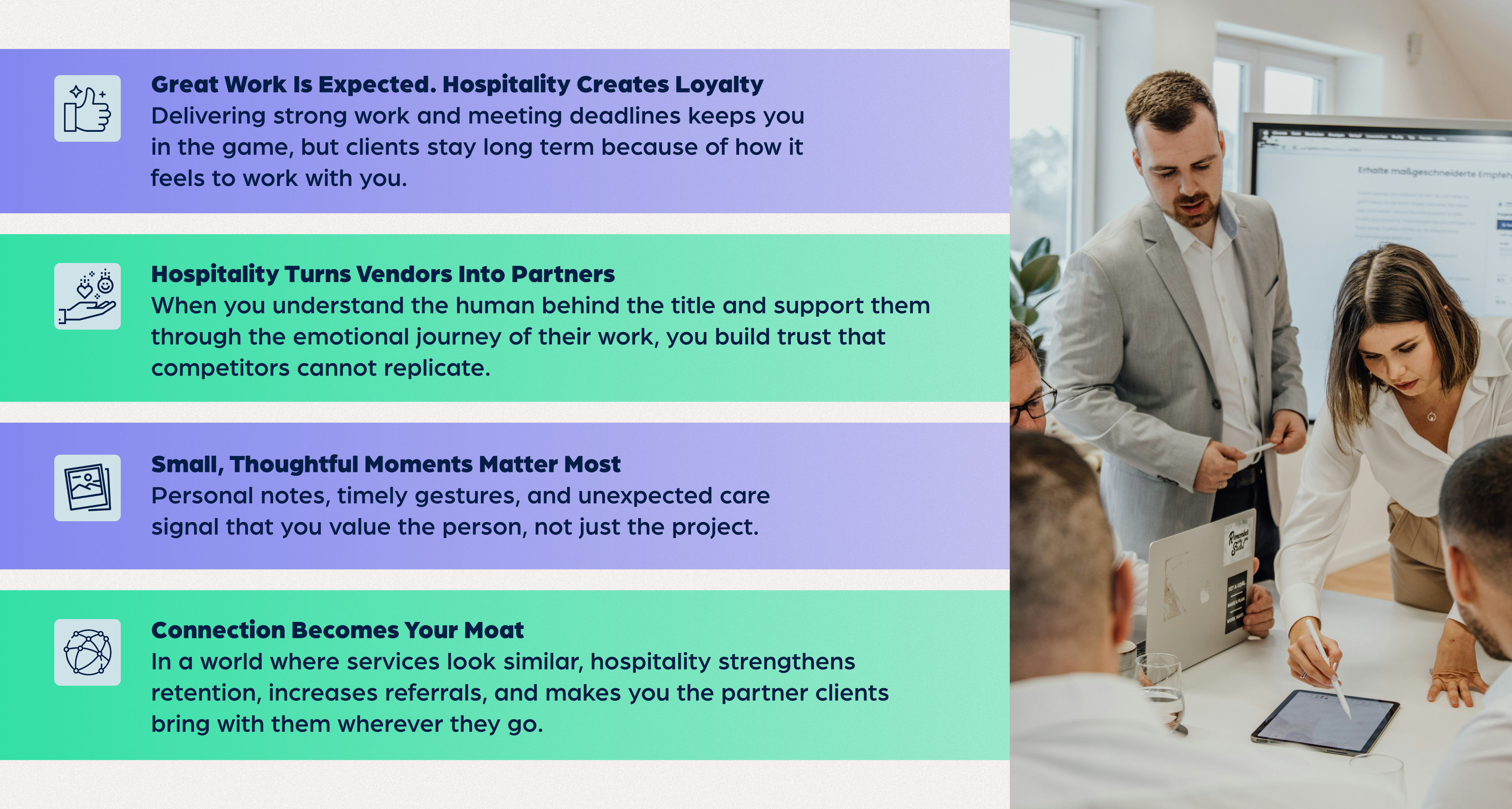
These are essential, but they are only the baseline. They are not what create true loyalty.
The clients who stay for years, renew even when budgets shrink and bring you with them when they change roles almost always do so for a different reason. They stay because of how it feels to work with you.
This is where hospitality comes in. Not the restaurant version of hospitality, but the intentional, human centered experience you create inside your agency. Hospitality is what transforms a vendor into a partner. It is what makes clients feel cared for, understood and supported in ways that go beyond the scope of work.
Hospitality Is Not Just For Restaurants
In the book Unreasonable Hospitality, the author shares a powerful story about having dinner with his father after a devastating personal loss. What should have been a normal restaurant visit instead became a four-hour experience that gave them a temporary oasis from grief. The chef stayed late, offered a quiet tour and didn’t charge them. The staff treated them as if they were the only people in the world.
Their pain did not vanish, but they felt seen and held. That is hospitality.
It is not about bringing plates out on time or doing the job correctly. It is an intentional choice to show up for another human and silently communicate:
“I see you. I care about you. You matter.”
You may not run a restaurant, but you are absolutely in a service business. You sit beside people during:
- High stakes product launches.
- Campaigns that influence someone’s career.
- Brand shifts that feel deeply personal to founders.
Hospitality is your opportunity to make clients feel safer, more supported and more understood during moments that genuinely matter to them.
Great Work Is Expected. Connection Is Not.
If a client is paying professional fees, they assume:
- Work will be high quality.
- Deadlines will be met.
- Performance goals will be pursued.
- The scope will be delivered.
That is the minimum standard. Great work earns you the right to stay in the conversation. Connection is what makes you irreplaceable.
Clients leave agencies even when the work is solid because:
- They never felt truly understood.
- Every interaction felt transactional.
- They did not feel safe sharing the messy reality.
- They never felt you were genuinely with them.
On the other hand, clients stay with agencies that:
- Make them feel smart and supported.
- Anticipate needs before they arise.
- Remember their world beyond the brief.
- Show up when life and work get difficult
This is the difference between being a vendor and being a partner.
What Agency Hospitality Looks Like
Hospitality is not about lavish gifts or performative politeness. It is about building a relationship through thoughtful, intentional choices.
Know The Human Behind The Role
Your client is more than a title. They are a person navigating goals, pressure, family life and personal milestones. Agency hospitality means paying attention to what matters to them, such as:
- What success looks like in their role.
- Personal or professional milestones approaching.
- How they prefer to communicate.
- Interests or hobbies they casually mention.
This does not require prying. It simply means being observant. When you know the human behind the title, you naturally adjust the way you communicate and make recommendations that align with their motivations and stress points.
Support The Emotional Journey Of The Work
Every project has an emotional arc. Clients move through excitement, uncertainty, worry, anticipation and sometimes fear. Hospitality is staying present during that journey, not only during high performance moments.
This might mean:
- Encouraging them before a board presentation.
- Calling out small wins so progress feels real.
- Creating space for open conversations when something feels off.
- Owning mistakes quickly to restore trust.
You are doing more than delivering assets. You are helping them navigate the emotions that come with leading change inside their organization.
Create Moments Of Surprise And Delight
Some of the most impactful hospitality moments are small, thoughtful surprises that show clients they were on your mind. Examples include:
- A handwritten note celebrating a promotion.
- A small gift connected to an inside joke from a call.
- Lunch delivered on an intense launch day.
- A video walkthrough that simplifies a complex report.
These gestures are powerful because they are not required. They communicate care. They communicate attention. They communicate that you value the person, not just the project.
Practical Ways To Bring Hospitality Into Your Client Relationships
Hospitality becomes simple when you build it into how you work.
Create A Simple Client Human File
Alongside project notes, capture meaningful details clients have already shared. Not a deep dossier, just basic context such as:
- Birthdays and anniversaries.
- Family details.
- Hobbies or interests.
- Personal goals.
- Big events coming up.
This gives your team a reference point so interactions feel personal and consistent, no matter who touches the account.
Celebrate Life And Business Milestones
When you pay attention, there are countless opportunities to acknowledge important moments. A message for a birthday that feels specific. A gift when they welcome a new baby. A note when they hit a career milestone. A toast when you achieve a shared metric.
What matters most is thoughtfulness. A mass branded gift is marketing. A timely, relevant gesture is hospitality.
Show Up When They Are Under Pressure
Clients will move through seasons of stress. You can see it. A job change. A move. A reorg. A launch they must get right. These moments are opportunities to support them.
Hospitality might look like offering to help prep for a presentation, taking a couple of tasks off their plate, sending a message acknowledging the weight of their week or gifting them something restorative when the sprint ends.
You become someone who makes difficult seasons feel less lonely.
Add Surprise To How You Deliver The Work
The way you present your work can elevate the experience. For instance:
- Mailing a printed, bound strategy that feels special.
- Including a short video walkthrough to simplify dense content.
- Adding a section explaining what the outcome means for their career.
Small touches shift the way the work lands. You are not only delivering an outcome. You are creating an experience.
The Business Case For Hospitality
Hospitality is not only about kindness. It creates measurable business impact.
- Retention increases because clients feel emotionally connected.
- Expansion becomes easier because trust is deeper.
- Referrals rise because clients love recommending partners who make them look good.
- Stakeholders bring you into future roles because the relationship has real meaning.
In a world where agencies can replicate services, portfolios and pricing, hospitality becomes a competitive moat. Others can match your capabilities. They cannot easily replicate genuine relationship and care.
Making Hospitality A Habit Without Losing Authenticity
A bit of structure helps hospitality become consistent without feeling formulaic. Consider practices such as:
- Allowing each team member to choose one client each month for a thoughtful gesture.
- Spending a few minutes in weekly meetings identifying clients who may need extra care.
- Keeping a shared list of meaningful gesture ideas so no one starts from zero.
- Tracking client milestones in your calendar so important moments are never missed.
The purpose of the system is simple. It should support your humanity, not replace it. The goal is to make thoughtful action easier, not robotic.
When Clients Feel Seen, They Stay
Retention is not just a pricing problem, a positioning problem or a performance problem. At its core, retention is a relationship problem.
If you are delivering strong work and still losing good clients, the missing piece may be how they feel when they are in your world. Hospitality bridges that gap. It is not about perfection. It is about intention.
Treat clients as humans first, titles second. Build small rituals of care and surprise. Show up when it matters most, not only when things are going well.
Great work keeps you relevant. Hospitality makes you the partner they want to keep around.