
Every agency owner seems to have an opinion about AI. Some believe it is overhyped; others think it will transform the industry, and many are experimenting with tools without knowing whether those tools are actually improving the business.
The problem is that AI decisions are often driven by hype instead of economics.
Agencies either invest in tools without knowing whether they will create a meaningful return, or they avoid AI because they are skeptical of what it can realistically accomplish. Neither approach provides a useful strategy.
Instead of asking, "Where can we use AI?" ask a better question: "Where can AI reliably reduce the time or cost required to complete repetitive work without sacrificing quality?"
That turns AI adoption into a business decision rather than another trend to follow.
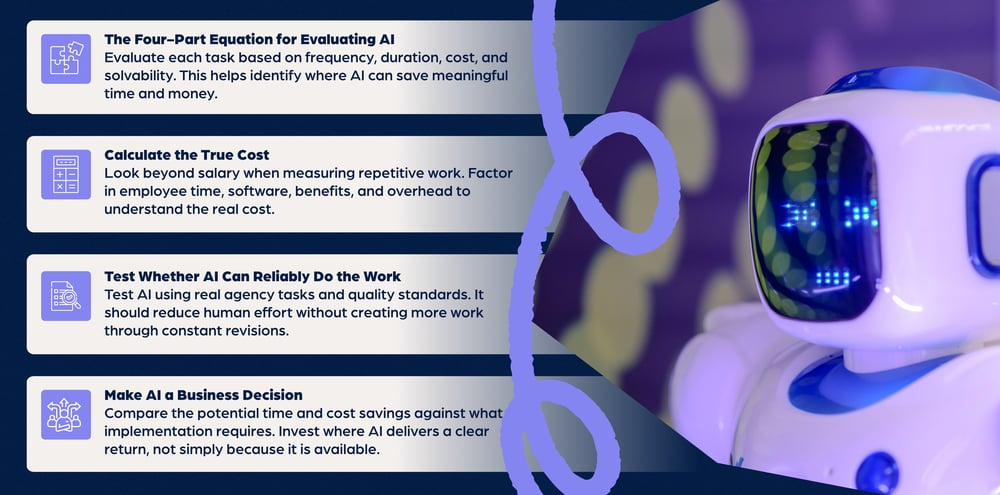
The Four-Part Equation for Evaluating AI
You do not need a complicated AI strategy to identify worthwhile opportunities. Start by evaluating repetitive work using four factors:
- Frequency: How often does the task happen?
- Duration: How long does it take each time?
- Cost: What does that time cost your agency?
- Solvability: Can AI consistently complete enough of the task at an acceptable quality level?
- Reporting, project updates, meeting preparation, and administrative work
- First drafts of briefs, proposals, emails, and client communications
- Research, competitive analysis, data organization, and information gathering
- Development and implementation costs
- Ongoing software, usage, and maintenance expenses
- Expected labor savings and how long it will take to recover the investment
Together, these questions help you identify where AI could create measurable value.
A small task may seem insignificant until you discover that several employees perform it multiple times each week. Meanwhile, a complicated task that happens only occasionally may not be worth automating.
The goal is not to automate everything. It is to find repetitive work that consumes valuable capacity and determine whether AI can reduce that burden.
Step 1: Audit the Repeatable Work Inside Your Agency
Start by looking at what your team does every week rather than brainstorming impressive AI applications.
Review several weeks of activity and identify recurring tasks across operations, client service, strategy, and administration. You are looking for work that happens frequently enough for even modest time savings to become meaningful.
Common opportunities include:
Some of the best opportunities may be hiding inside tasks that feel too small to address. A short project update is not expensive by itself, but when multiple employees repeat that process throughout the week, the total cost can become significant.
Step 2: Calculate the True Cost
Once you identify recurring tasks, determine what they cost.
Look at how frequently the task happens, how long it takes, and the cost of the person completing it. When estimating that cost, remember that salary is only part of the equation.
Payroll taxes, benefits, software, equipment, and other overhead all contribute to the fully burdened cost of an employee.
This changes the conversation from, "This task takes too long," to, "This process costs the agency this much every month, and we believe AI could reduce that cost."
That gives you something measurable.
It can also reveal where highly skilled employees are spending valuable time moving information, preparing updates, or completing repetitive administrative work instead of focusing on strategy, creativity, and client relationships.
Step 3: Test Whether AI Can Reliably Do the Work
An impressive AI demo does not mean the technology can reliably perform a task inside your agency.
Test AI using real examples and compare the output against the quality your team requires. The important question is whether AI can consistently reduce the amount of human effort needed without creating so much review and correction that the savings disappear.
The answer does not have to be all or nothing.
If AI can create a strong first draft and an experienced employee can quickly review and finish it, that may represent meaningful savings. If your employee has to rewrite almost everything, the economics are much less compelling.
A failed test is still valuable because it tells you that the task may require better data, more context, a stronger workflow, or more human judgment.
AI should earn its place in the process.
Step 4: Compare the Savings Against the Investment
A task can be technically solvable with AI and still be a poor investment.
Before implementing a new workflow, compare the savings against the full cost of building and maintaining it. That includes more than the price of an AI subscription.
Consider:
If the savings are substantial and recurring, the investment may make sense. If the cost difference is marginal, changing the workflow may create more disruption than value.
ROI matters more than novelty.
Where AI Can Make Sense for Creative Agencies
For many agencies, the strongest AI opportunities are likely to exist around operational work rather than the creative thinking that differentiates the business.
Reporting and client updates are good examples because they often involve collecting, organizing, and summarizing existing information. AI can potentially create the first pass while an account manager adds the judgment and context the client needs.
The same approach can work for proposals, briefs, and research. Your team provides the strategy, inputs, and expertise, while AI helps accelerate repetitive processing and drafting.
Think about AI similarly to a calculator. A calculator can process information quickly, but someone still needs to understand which formula to use and what the result means.
Your team still determines which questions matter, whether the output makes sense, and how that information should influence the client's strategy.
AI does not have to replace the thinking to improve the economics.
Stop Telling Your Team to "Figure Out AI"
One of the easiest ways to create frustration is to buy an AI tool, give everyone access, and tell the team to figure out how to use it.
Your employees already have client work, deadlines, meetings, and responsibilities. Asking them to independently redesign their workflows around new technology creates another project without giving them a clear definition of success.
Instead, start with a specific business problem.
Identify a repetitive process, measure its current cost, test whether AI can improve it, and evaluate the results. If the economics work, implement the workflow and move to the next opportunity.
This gives your team a clear reason for changing how the work gets done rather than creating pressure to "use more AI" simply because everyone else is talking about it.
Make AI a Business Decision
AI capabilities will continue to change, which means a task that is difficult to automate today may become a strong candidate in the future.
Your decision-making process does not need to change every time a new tool appears.
Start with one recurring task. Determine how often it happens, how long it takes, and what it truly costs. Test whether AI can reliably reduce the human effort involved, then compare the savings against the cost of implementation.
If the economics work, move forward. If they do not, move on.
As you free up capacity, make sure your team knows where that time should go. Otherwise, the hours you save can easily disappear into different forms of busy work.
The goal is not simply to use more AI or get more work done.
The goal is to use technology where the economics make sense so your people can spend more of their time on strategy, creativity, client relationships, and the work that creates the most value.